Irini Georgi

Cornell 7, male friendships, group chats & the digital bystander effect

A while ago, I made an Instagram post that said the following:

“Men are so strong, fearless and protective that they claim they’d be willing to take on bears, gorillas and tigers to save a woman, but they don’t dare tell their friends to stop making sexist jokes, harassing women or raping them.”

And then, naturally, a hoard of misogynists showed up in the comments to bully and insult me. “Are you saying there are men who tell their friends to rape or harass women?”

I kept explaining that what I was actually saying was that most men hear or see things that could indicate their friends are harassing or raping women, BUT THEY SAY NOTHING.

I’d even made a video explaining exactly what we want men to say to other men in different situations. (I’ll put the text towards the end.)

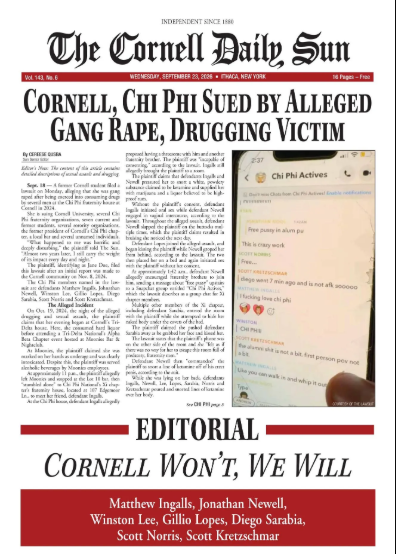
And then the Cornell case broke.

A few days after I learned what had happened, I posted a video about the horror Jane Doe had experienced. But I ended it with the thing that was troubling me the most: the group chat.

Because, yes, seven men (allegedly) decided to gang-rape her. But what did the other 50 men in the group chat do?

That was what I couldn’t stop thinking about. Almost more than the gang rape itself. Why?

Because there’s nothing we can do for the men who decide to rape someone. It’s too late. Teaching them about consent, or anything else, isn’t going to help. Even as someone who believes deeply in education, I know perfectly well how naïve that idea is. How delusional, actually. The problem wasn’t that these guys confused not saying no with “yes.” No.

Men like these know exactly what they’re doing. For them, the absence of consent is a bonus. It’s what they want. They want to dominate, humiliate and degrade a woman who doesn’t want to have sex with them, and is unable to fight back. And they want to high-five each other and bond through the whole experience.

For men like these, it’s too late for education. So the real issue is everyone else. The men who know what’s happening but don’t intervene.


Women’s Friendships vs. Men’s Friendships

The patriarchal stereotype about women’s friendships is that they aren’t true friendships, and that women are constantly fighting with one another. Part of this may have to do with the fact that women share genuine emotions with their friends rather than simply playing video games, playing sports, watching sports, or doing other activities together. (Is watching fishing a thing?) Their relationships are therefore deeper and more meaningful, involving vulnerability. But perhaps there’s something else going on, too.

Perhaps it has to do with the fact that when women see their friends doing something wrong, when they recognise shitty behaviour, they don’t automatically take their friend’s side. They don’t forgive everything as long as they themselves aren’t the target of the bad behaviour. They don’t blindly cover for their friends. They don’t look the other way. They don’t sweep things under the rug. They don’t say, “Oh, it’s okay, she’s my friend.”

If a friend does something wrong, not just to them or to another friend, but to anyone at all, women make an issue of it. They hold them accountable. They demand explanations. They expect repair and a change in behaviour. And if that isn’t enough, they cut them off.

That’s the difference.

Men proudly claim that male friendships are unshakeable and honest, and that men tell it like it is. Yet within their friendship groups, they avoid talking about anything that might disrupt the balance or challenge the stereotypes. They avoid rocking the boat.

They don’t call out problematic behaviour unless it’s directed at someone in their own group. Otherwise, and especially when it comes to women, even when they don’t actively bond through misogyny, they accept whatever their friends do without questions, accountability, consequences or confrontation.

“I didn’t see anything. I don’t know anything. I’m saying nothing.”

That, after all, is the bro code: a code of silence, himpathy and male solidarity.

Enter the Digital Bystander Effect

In a group chat, silence doesn’t necessarily mean agreement. But when everyone stays silent, the group can interpret that silence as agreement and acceptance. And that feeds a culture of violence, hatred and rape.

The digital bystander effect is the online version of the well-known bystander effect: the more people are present when something problematic is happening, the easier it can become for each individual to do nothing. It’s a paradox. The presence of many people makes each person less likely to take personal responsibility.

Responsibility becomes diffused throughout the group. “Someone else will speak up.” “Someone else will react.” “It’s not my business.”

In group chats, this is reinforced by the absence of the immediate social pressure that comes with a face-to-face reaction. You can read a message, say nothing and carry on with your life. People often choose passivity because they don’t want to get involved or draw attention to themselves.

In male group chats, this becomes particularly significant. Nobody wants to break the bro code and risk being cast outside the man-box. So countless men choose to remain silent, even when they disagree with what’s being said.

But they don’t have to agree. If 57 men see a message like that (or any message that objectifies or targets women) and nobody reacts, the silence acts as a social stamp of approval and acceptance. It’s digital locker-room talk, as Trump called it.

The person who sends the message encounters no resistance, and everyone else learns that this is a space where such things can be said without consequences. The sense of anonymity, distance and protection offered by a digital environment or a closed group can make people feel less accountable for what they say.

But words turn into actions. And we know that, from elite universities to the White House and the Epstein Files, closed groups can shape society as a whole and wield enormous power.

And yes, even Cornell lecturers agree that fraternities should be abolished. But fraternities are simply extreme versions of male friendship groups, where institutional rules don’t matter. The only rules that count are those of stereotypical masculinity.

Because patriarchy teaches men that they have two choices: be the hammer or be the nail.

Even if a man doesn’t really want to pick up the hammer, he sure as hell doesn’t want to be the nail. So he chooses the hammer. He can’t hit those above him on the hierarchy, but he’d better get busy hitting those below him.

He makes fun of men who rank lower on the masculinity scale, of “betas,” “simps” and weak men. He laughs at them. He bullies them. He puts them in their place. Whenever another man does something considered unmasculine, he insults him by calling him gay. He ridicules gay men. He keeps as much distance from them as possible.

And, obviously, he must be above women at all costs. He must keep them down, boot-on-neck.

Men are rewarded with status, safety, a sense of belonging and acceptance when they dominate women. In their everyday lives, masculinity is policed far more harshly than morality. And if a man values dominance, feeling powerful and proving his manhood more than he values not harming a woman, then rape becomes an almost… unforced outcome.

The consequences of being caught acting “feminine” are far worse than the consequences of acting immorally. Harming others is acceptable, while violating the rules of masculinity is unforgivable. You need power over women to preserve your masculine identity, and that requires constantly proving that you are man enough.

This is patriarchal male bonding, and it can start as early as primary school.

Right now, the only thing that can make a difference is the personal choice each man makes.

And let me remind you of something I’ve been saying for years:

Sometimes, saying “but I didn’t do anything” is not an excuse. Admitting you didn’t do anything, is a confession.


What can you do as a man, personally?

You can choose whether or not you want to maintain friendships that help sustain rape culture.

If you want to be a good man, speak up. Stand against cruelty, hatred, racism, homophobia and any behaviour you know harms people. Even if it costs you some friends. Yes, it takes courage. It takes bravery. But us feminists, we believe in you.

What if you’re in a group chat and someone says something you know is wrong? Something that perpetuates harmful stereotypes or could hurt women or other oppressed groups?

Don’t stay silent. Don’t be a bystander. Intervening doesn’t necessarily mean giving a lecture or publicly denouncing your friend. You can interrupt or defuse the message, name the problem, explain why it’s problematic or, when there’s a more serious risk, seek help or privately support the person being targeted.

What can you say to your friends when they talk about women?

  • If you hear jokes portraying women as inferior, stupid, crazy or fitting any other negative stereotype, don’t laugh. Ask: “What do you mean by that joke? Explain it to me.”
  • Say: “Don’t call women whores. If you do it again, you’re out of this group chat.”
  • Say: “Don’t talk about women as if they were objects or pieces of meat. Women are human beings.”
  • Say: “Rape jokes aren’t funny. Cut it out.”


What if it’s about dating and sex?

  • “She’s drunk. If you take her home, she can’t give consent.”
  • “Leave her alone. It’s obvious she’s not just not-interested, she’s actively trying to avoid you.”
  • “You’re being creepy / you’re violating her boundaries/ you’re making women uncomfortable.”
  • “Don’t touch women unless they’ve clearly shown you they want you to.”
  • “Don’t keep insisting or pressuring her for sex if she’s told you she only wants kissing and cuddling.”
  • “If she doesn’t seem enthusiastic, stop.”
  • “Silence doesn’t mean yes. If she doesn’t seem genuinely keen, why not just watch a movie instead?”
  • “Being in a relationship doesn’t mean automatic consent. She needs to say yes. Ask her if she wants to.”
  • “If she says no, stop insisting. Don’t try to convince or pressure her.”
  • “What she was wearing, where she was or how much she had to drink, has nothing to do with whether she wanted it.”
  • “It’s never her fault if you crossed her boundaries.”
  • “It’s not her responsibility to protect herself from what we do. It’s our responsibility not to harass women, violate or rape them.”
If you want to talk about this, in a personal or group session with your friends, just fill in the form below and I’ll get back to you.
Share:

Why are so many men obsessed with beautiful women?

It seems obvious, but it’s not what you think. Everyone is attracted to beauty, but for many men, the pursuit of the most beautiful woman becomes an obsession. Let’s explore why.

Symbol

For many men, a beautiful woman isn’t just attractive. She’s a symbol. She symbolizes that they’ve “made it” in life. That’s why we talk about the “trophy woman.” It’s not about the woman, it’s about the man. Men who choose women solely based on appearance have learned to evaluate themselves through their success.

 Self-Esteem

We’re talking about performance-based self-esteem. When someone’s self-worth is built solely on performance (professional, social, sexual), then their choices are often filtered through what enhances that image, in order for them to feel like they’re enough.

Social Validation – Demands of Stereotypical Masculinity

A beautiful partner isn’t just a romantic choice, she’s social validation. It’s the male version of “what will people say.” What will other men say? How much will they admire me, envy me, respect me? How well will I prove that I’m man enough and that I’ve succeeded?

Disappointment

And yet, choosing the most beautiful woman they can “get” often creates anxiety, fear of rejection, and a deep sense of inadequacy. Later on, it leads to loneliness and unhappiness, because the relationship is based on external variables, not substance. They choose women with whom the relationship lacks depth, but they don’t allow themselves other criteria, because society demands this of them.

Patriarchy

This entire structure rests on patriarchal foundations. Because in patriarchy, a woman’s value is tied to her appearance, and a man’s to his earning power. Relationships become transactions. These beliefs are still passed down by fathers and reinforced by society, so boys grow up believing that only this formula will earn them approval and happiness. But that’s a lie.

If you’re a man and this resonates, ask yourself:

What does it mean to me to have a beautiful partner?
How does it affect the image I have of myself?

  • What am I afraid will happen if I choose a woman based on other traits, like character, compatibility, emotional connection, instead of looks?

  • How do I feel when I’m next to a very beautiful woman? Do I feel fear, self-doubt, or a need to prove something?

  • How is my value as a man tied to the woman I have next to me?

  • If I couldn’t rely on looks to choose a partner, what other qualities would be important to me?

These questions will help bring you closer to your true desires, beyond the stereotypes, and give you a trusted guide so you can track, find and pick the right partner for your authentic self.

Share:

How did the manosphere become so popular?

Between the panic that all incels will turn into femicide perpetrators and the humor offered by alpha male influencers, let’s take a moment to understand why this is happening.

The global rise of feminism through pop culture and social media opened doors for many women’s communities. Women found empowerment spaces, gained platforms to speak, and for the first time, the world was (somewhat) paying attention. And the general message was “men are trash” for reasons we all know (which of course doesn’t mean all men, or that they are actually trash). But many men started feeling targeted.

Even worse, they felt marginalized. The manosphere was never made for handsome, wealthy men, but for the underprivileged—those who felt excluded from the dating scene (basically from sex), from relationships, and from love. For men who are poor and considered unattractive, and who are mostly not highly educated, it seemed like some kind of solution.

These men may have experienced rejection or even contempt from women in their lives, and haven’t processed the pain. Many may not have even dared make a move toward women, because they lack basic social skills. According to manosphere advice, all one needs is confidence, to lightly insult the woman, and to speak in riddles—then you can get any woman into bed.

These underprivileged men have been experiencing what’s been called the “male loneliness epidemic” for years. And they’re suffering. They needed someone to listen to their problems, someone to speak to them, when Hollywood, flashy influencers, and mainstream culture left them out. They needed guidance. There was a huge gap in the market.

And it didn’t take long for something to fill it. It started in gaming forums, and then expanded to other forums (4chan, Reddit), where they shared experiences, thoughts, and feelings—and this was genuinely positive, because many young men who had lived in social isolation finally gained a sense of community. They needed support—and they found it.

With the rise of video content, some figures stood out and became influencers. Some, like fitness influencers, pivoted into this niche because it was so lucrative. That’s how we got people like Jordan Peterson, who came with the seal of academic legitimacy (though he’s now been cast out of the academic community). He sensed the market demand for male role models and pseudo-scientific authority, exploited it, and became famous.

The problem is, instead of identifying the real enemy behind male oppression—which is The System, specifically Capitalism and Patriarchy (and White Supremacy)—they decided their enemy was feminism. In a distortion of reality, they use feminist arguments to convince their audience that men are victims of feminism. They quote stats on suicide, depression, addiction, etc., as proof. But they refuse to see that it’s patriarchy, the man-box, and the demands of stereotypical masculinity that are to blame.

They don’t blame patriarchy—because that would mean relinquishing privilege and comfort. So it’s more convenient to blame women and feminism. Why? Because feminism gave women the ability to survive without marrying, and the choice to not pair up with men they don’t like—in other words, not with them, the men who believe access to sex should be their right. So, feminism, and anything progressive, is the enemy.

And because a return to “traditional values” implies conservatism, all of this became embedded in alt-right rhetoric (which is not “alt” at all, but far-right). It became a package deal. While the manosphere crowd believes it’s unfair to have to pay for a woman’s coffee if they manage to get a date, at the same time they want right-wing politics and hate woke culture.

They don’t see the truth. And it’s ironic and tragic that they see as an enemy the very movement that is actually on their side—the movement that could genuinely improve their lives. Not by offering them sex. But by offering collective healing tools that could make relationships with women possible.

History of the Manosphere

It began in the early 2000s as a collection of blogs, forums, and YouTube channels focused on men’s issues. At some point, it started to function as a counter-movement to feminism.
The term “manosphere” emerged around 2009–2010 to describe the online ecosystem where these ideas developed.

Its foundations were built on older men’s movements, like the Men’s Rights Movement (MRM) from the 1970s–80s, which focused on divorce, child custody, and false rape accusations.

2000s–2010s:
Pickup Artists (PUA) led by gurus like Neil Strauss with his book “The Game”, which taught men how to “seduce” women—basically by saying things like “I like you, even though you’re a bit chubby” to get them into bed.

Mid-2010s:
The rise of Red Pill ideology (named after The Matrix), promoting the idea that men must “wake up” and realize that women actually hold power in society, while being inferior, dirty, immoral, etc.

2016–present:
Incels—the evolution of Red Pill thinking. Men who hate women and feminism for denying them access to sex.

MGTOW (Men Going Their Own Way):
Men who completely give up on the idea of relationships.

Connections to the far-right, white supremacy, anti-LGBTQ, and anti-woke rhetoric grow.
We see the rise of the “hustler” ideal through crypto culture—the man who makes loads of money and has as many women as he wants, using and exploiting them like objects. (See: Andrew Tate.)

Core Beliefs:

  • Biological determinism: Gender roles are biologically predetermined, and it’s foolish to try to escape them.
  • Men as victims: Men are the oppressed ones; we live under matriarchy; feminism is misandry and “feminazism.”
  • Cheap self-improvement: At the beginning, there was talk about self-care, confidence, and fitness—but misogyny got way more views. Over time, self-improvement shifted from a process of inner growth and healing into a performance of dominance and control. Instead of fostering emotional maturity, it became a show—a curated display of masculinity, power, and “social value.”
  • Monetization: Enter hustler culture, with millions of desperate men paying for subscriptions to ridiculous “gurus” offering seminars on how to get women or make money—naturally, with little to no real results. The promise was always the same: quick success, sex, power. The reality? Usually full of disappointment and burnout.

Impact

  • Connection to violence: Incels who went out and shot people (e.g., Elliot Rodger, 2014).
  • Platform bans: Reddit, YouTube, and Facebook started limiting manosphere content (2018–2020), but TikTok let them run wild for far too long. In 2022, Andrew Tate was banned, but he remains a legend, with countless others trying to take his place.
  • Legacy: There are still online corners where the manosphere thrives, but it’s no longer quite as “cool.” The “gym bro podcasts” are everywhere, but they’ve become meme-worthy. The slightly more polished successors of this ideology have shifted to life coaching and dating coaching, always with an emphasis on confidence—but still rooted in the same old worldview.
Share:

The Netflix series we needed

I made a video a while ago where, at the beginning, I mentioned that teenage boys can be somewhat scary and intimidating to women. A lot of people were outraged in the comments—why was I saying that? What did I mean? I explained:

“Teenage boys go through a phase where they need to prove their masculinity to one another and to the outside world. It becomes a performance, a spectacle, and unfortunately, this often translates not just into shouting loudly and swearing but also into harshness—because that’s what patriarchy has taught them. That sweetness and kindness are signs of feminine behavior and weakness, things to be avoided at all costs.”

In the introduction of my book, Who Women Want, I say that not all women want the same thing—because women are people. They are not bees with a hive mind.

The closest thing to a hive mind isn’t found in women but in boys growing into men. Not because boys are less intelligent or because they are simple creatures—none of that nonsense, don’t worry.

It’s because of the man-box. These characteristics that become the “masculinity meter,” the standard by which boys measure and evaluate one another, and anyone who deviates is pushed to the margins. That’s why breaking the cycle of stereotypical masculinity is so difficult—because of fear. Boys are constantly weighing and testing one another in a relentless effort to prove they are “man enough,” so they don’t fall in the hierarchy and risk being ostracized. Keep that word in mind.

Sophisticated, educated (or posh) types like us, who stand on the other side and fail to see the suffering of boys, who only see the shouting, the swearing, the bullying, and the behaviors we label as “toxic masculinity”, we bear responsibility.

We are the ones who use difficult words like ostracized and exclude them, and right when we talk about dismantling privilege, we flaunt it.

The anger toward difficult words reminded me of a play I watched last year that had me crying from start to finish: Another Thebes. It reminded me of a young man I once dated. We’d met online—our lives ran on parallel tracks, and we would never have crossed paths in real life. I called him The Bronx. I’d written about him:

“His vocabulary consists of about a hundred words. He’s uninterested in anything beyond his own life. He doesn’t read, gets bored even watching movies, and finds nothing enjoyable except women, motorcycles and food. We have absolutely nothing in common. He constantly insults me, belittles me, and sometimes it’s exhausting.

But I ignore it. I don’t know how I realized this, but I know he doesn’t mean any of it. And I don’t take it to heart, which even impresses me. It’s like he has to say these things, so I don’t think he’s ‘soft,’ so he appears strong in my eyes, to maintain some invisible, unknown standard that I can’t even fathom. He insults me and I tell him I want him. He replies with a hundred kisses, tells me he’s thinking of me, then insults me again—then says he wants to hold me tight.

He would get angry whenever I used difficult words—angry at me even though he was actually angry at himself.

One day, we had ordered pizza. We were sitting on the bed, and he was still eating. At that moment, I had let my guard down, and without thinking, I reached out and stroked his beard. It lasted a few seconds. He turned to look at me. Oh shit, I messed up, I thought—he’s going to have a go at me.

Instead, he said, ‘Irini, I have pizza, music, and you stroking my beard. It doesn’t get much better than this. I don’t know how I’ll ever get over it.’ And he didn’t say it sarcastically. But of course, right after that, he took it back and started insulting me again.”

Sometimes, you get a glimpse of the boy beneath the mask. Sometimes, they show it to you on purpose—because they know that you, the overly emotional woman, crave to see it. It’s precious to you, and you’ll do anything to protect it. So they show it to you in order to take advantage of you.

But sometimes, they can’t control it, and the mask falls. And beneath the man, there is the boy.

“Do you like me?”

That desperate need to be accepted and loved—a need that both men and women share. But men are only allowed to satisfy it through sex. The fact that they aren’t allowed anything else destroys them—because on some level, they know.

They see what they’re missing. They see the magical world of women, full of sharing, emotion, and touch that isn’t shameful. They see it through the glass, like The Little Match Girl, and they know it’s not for them.

A tenderness they can’t touch. And that makes them angry, but with a rage that has no clear target. They don’t know how to be angry at society, and they’re not yet capable of being angry at themselves. (That comes later—with addictions, gambling, substances and other self-sabotage and self-destructive habits).

So they get angry, because anger is the only negative emotion men are allowed to express. But beneath the tip of the iceberg, it’s not anger. It’s sadness. It’s grief. It’s the pain of losing something they never had, but could have had, if only they weren’t required to be men.

And when women deny them sex, the only form of intimacy they’re allowed to seek, that makes them even angrier. A rage that terrifies women, forcing them to live in fear. And so they get angry too. They insult men—all men—because they want to stop fearing them. And men, in turn, get even angrier, hating the women who reject them because they fear them. Many find comfort in the arms of the manosphere.

Even when they’re in relationships, many men only get a fleeting glimpse, just a sliver, of what true freedom could feel like. The freedom to not constantly fear your own shadow in a world that judges you by how masculine you appear to be. The freedom to be accepted as you are, to be told you are enough. A mere idea of what love might feel like. But that light and brilliance scare them because they’ve spent their whole lives in the dark.

They become avoidant. The tenderness of staying is unbearable. Just as they get close, they pull away again. The light is not for them. They prefer to keep a safe distance, wearing loneliness as armor, fortified in their stronghold of self-sufficiency and autonomy. This is the prison of masculinity—even within a relationship, even within a marriage.

I’ll bring money home and protect you (from whom?), and you’ll have food ready, sex available, a clean house, and care for me when I need it. Closeness and connection, in moderation, because it is blindingly terrifying.

And women are left with bitterness, which is a mixture of pain and shame. The bitterness of an overflowing river of tenderness that has nowhere to go because the one it’s meant for refuses to receive it, except as home care or emotional labor. Tenderness that freezes and hardens instead of flowing from its spring.

The light is not for them—unless they were lucky enough to have parents who had all the colors on their palette and the willingness and ability to paint outside the lines. The invisible privilege that becomes a kaleidoscope. Parents who were emotionally present. Parents who were intentionally boring. Parents who were generous givers, both in words and actions, of love and attention, love for who you are, not for what you achieve or accomplish. Predictably, consistently, unwaveringly.

Except for the rare few who managed to do it alone, even with parents in the grey. The greatest challenge is transcending masculinity itself. It’s what we beg men to do, but they won’t do it just because we beg. No matter how much we beg. It’s a singularity—a space-time anomaly. They need the right stimuli at the right moment, repeatedly, aligned with a sequence of experiences that slowly confirm an initially vague and unformed idea: Maybe something in the world we know isn’t quite right.

And once the singularity occurs, it takes effort—an effort few are willing to make. It takes curiosity. It takes time. It takes energy. But above all, it takes what we hear in therapy: lean into the uncomfortable. To lean in and sit with discomfort. Until it becomes familiar. Because new ideas and beliefs can be uncomfortable at first—like new shoes. You have to try them on, walk in them, break them in until they become part of you, fitting you perfectly, until you never look back. Not just because you chose them, but because if you ever try to wear the old ones again, you wonder how you ever endured the rotten soles and the holes that let water seep in.

“How did you feel when your father looked at you with shame?”
We talk about the male gaze toward women, but not about the male gaze toward men. The gaze that measures and evaluates. Are you man enough? And so many boys, so many men, feel ashamed of the male gaze upon them—because it finds them lacking, because ithe man they look up to is ashamed of them.

Shame—not for something they did, but for who they are.

“I don’t deserve hot chocolate; I shouted”
I don’t deserve that much grace. I don’t deserve that much kindness. I don’t deserve love for who I am because I am not good enough. Something inside me—or about me—excludes me from the privilege of being loved for who I am. Something, sometime, made me believe this. And I will carry it all my life, and so will those who come close to me. And if I don’t let it go, it will define me until I die. Or until I destroy another life.

“We have to accept that we could have done more.”
From this story, you will remember the boy. But you must also remember the father. He was as good as he could be, but he should have been better. How could he be better with the father he had? I don’t know. I do know that masculinity is a generational issue—and a social one.

We should have done more. Who? All of us.

Parents must be present. Teenagers must question their parents, they must stop seeing them as gods and recognize them as flawed human beings. And parents must accept this loss and step back, slowly, carefully, with a steady love and unspoken safety nets. Because only then can children move forward and surpass them.

The debt is not to the past but to the future.

The debt is to the next generation. But what do you do when the next generation moves backward instead of forward? When it rediscovers lies we thought we had left behind, repackaging them in new, shinier package, this time not in books no one will read, but in short-form videos with millions of views. Coated in baby oil on the arms of alpha male influencers on TikTok.

We were not prepared for this.

Parenting is the hardest job in the world, yet everyone is doomed to do it as an amateur. Clumsy, awkward, imperfect—at best. Or much, much worse. No matter how many resources, books, and mental health professionals exist, there will always be a gap in understanding. The world of teenagers will always be a mystery to the world of adults.

We were not prepared for the fact that while a child sits quietly in their room, staring at a screen, their life might slowly be unraveling. Invisibly. Silently. And boys have been taught not to ask for help. Why? Because they have to be men.

We should have done more. Who? Everyone. Children are not raised by their parents alone. They are not raised in a bubble or a greenhouse. Every child is shaped by every classmate and, therefore, by every parent at school. They are shaped by everything they see or read. By every celebrity who becomes a role model. By social media. By pornography. Every child is raised by society. We all take part in raising them. We need to do more.


Share:

The truth about incels

A modern feminist approach challenging the narrative & creating change

Incels are often seen as villains in many feminist circles. They are the enemy, just like feminism is their enemy. But there should be no war at all. In reality, the vast majority of men who identify as incels aren’t mass murderers but depressed, isolated and underprivileged men who harm themselves more so than others. Feminism ought to stand by their side, because feminism should mean empathy and solidarity.

The problem

Incels perceive themselves as having lower value as romantic or sexual partners than other men. They place excessive importance on physical attractiveness and financial prospects to attract women, and underestimate women’s preferences for intelligence, kindness and humour. Incels’ inaccurate perception of what women desire in partnerships, leads to blaming women as well as other men for their lack of romantic success.

The role of dating apps

Rejection on dating apps amplifies their beliefs, with adverse consequences on their mental health. They create a distorted self-perception with low self-esteem, develop maladaptive coping mechanisms, and avoid accountability for their actions. By projecting their insecurities onto external reality, they reinforce patriarchal values and dehumanize the women they seek to date, further reducing their chances of romantic success.

A vicious cycle

Rejection sensitivity refers to an individual’s heightened and often anxious response to the perceived possibility of rejection or social exclusion. It seems that in rejecting themselves and believing they will not be good enough for potential partners, incels believe everyone else will agree. This may contribute to self-isolation and hostile behaviour, making them more dismissive of others and resulting in an unfortunate self-fulfilling prophecy.

The solution

It’s time to stop blaming incels and start blaming the society that raised them. Unlearning harmful anti-feminist ideals and seeking education on women’s lived experiences, is the start. Learning to cultivate trust in humanity, building one’s self-esteem with deep work, by seeking social and mental health support and recognizing that romantic relationships are possible for everyone, is the key to creating meaningful change.

My work is to help and guide men through the path of escaping maladaptive thinking and behaviour patterns that harm them and their possibilities of forming healthy relationships. I can help men redefine their ideas of masculinity and femininity and understand the female experience. Understanding leads to empathy and empathy leads to connection, which is marks the start of relationships. Let me be part of your journey and guide you through. It’s time for change!

Share:

Men & Vulnerability

A challenge for men

Vulnerability has become the new buzzword in relationships, much like “empathy” was a few years ago. Since women overwhelmingly seek therapy and counselling to explore and understand their emotional inner worlds, there’s growing pressure on men to evolve emotionally to avoid being left behind.

However, this request often falls flat. While men may desire the courage to embrace vulnerability, as it sounds promising, they often grapple with internal resistance or societal expectations of masculinity. Traditionally, vulnerability suggests weakness, and it’s defined as being exposed to the possibility of physical or emotional harm.

Historically, male roles centered around strength, protection, and provision. Being asked to show vulnerability can feel like a threat, clashing with ingrained narratives of masculinity that discourage anything perceived as weakness. Failing to meet these standards often triggers fears of rejection and social exclusion.

Survival strategies from prehistoric times taught men to assess each other for weaknesses, as any sign of frailty was seen as a liability to the group. Such men were undervalued as partners and were in risk of losing social standing. This evolutionary instinct still prompts men to conceal any perceived vulnerabilities.

Brené Brown, known for her research on shame, redefines vulnerability as uncertainty, risk, and emotional exposure. Her perspective reveals the courage required to engage in vulnerable acts. Demonstrating bravery garners respect and admiration, not just from other men but also from potential partners, aligning with cultural “warrior” archetypes found in myths worldwide.

Today, many developed societies enjoy unprecedented physical safety, diminishing the need for male protection. Ironically, men now feel inherently vulnerable because the traditional protector role is less relevant. The diminished need for male protection challenges their sense of value and purpose, sparking a broader identity crisis.

Men’s existential need to be needed is significant and documented. Studies in the U.S. show that messages like “No one needs me” and “I’m worthless” are common themes in men’s suicide notes. Women’s economic independence has also shifted traditional dynamics, reducing men’s role as providers. Adjusting to this cultural shift in just a few generations is no easy feat.

Vulnerability is often misunderstood as merely expressing deep emotions, but it encompasses much more: asking for what you want, setting boundaries, requesting help, trying new things despite the risk of failure, and approaching a potential partner with the possibility of rejection.

In essence, vulnerability surfaces whenever our identity faces potential challenge or risk.


The value of vulnerability in relationships

In intimate relationships, vulnerability fosters closeness, a vital element for healthy connections. Sharing your truth invites genuine connection and builds trust. Revealing our authentic selves signals that we have nothing to hide and pose no threat.

People often conceal their truth in order to maintain a sense of control and security, avoiding discomfort. Healthy vulnerability requires discernment—knowing what to share, with whom, and when. It’s part of personal growth, pushing us beyond our comfort zones to explore new possibilities. Without venturing into the unknown, we miss opportunities for transformation.

Vulnerability demands courage—to face fears and take leaps of faith without guaranteed safety. While falling flat on our face and failing are very real, possibilities, each attempt teaches resilience and flexibility, making future challenges less daunting.


Can men be vulnerable and attractive?

There’s no universal answer, as women’s preferences vary based on upbringing, culture, trauma, and personal experiences. However, one general principle holds: vulnerability expressed from a weakened, self-deprecating place often feels uncomfortable for women. If a weeping man appears unable to care for himself, let alone his partner, it can be unsettling for a woman.

On the contrary, vulnerability is attractive when it stems from a man’s empowered self. When men accept themselves and strive for growth without seeking validation, they display strength—even in tears. This form of vulnerability isn’t weakness but courage: revealing imperfections without collapsing or begging for approval.

True vulnerability is an act of bravery, a willingness to take risks despite insecurity. By embracing this mindset, relationships can flourish, allowing deeper, more meaningful connections. Without such openness, relationships risk stagnation, becoming dry and unfulfilling.

Emotional closeness is the essence, the magical elixir that reveals the other person in their multi-layered wholeness and helps keep the relationship alive.

Vulnerability isn’t easy, but that’s its nature. Men can choose to remain attached to outdated standards of masculinity or become part of the new generation of men who opt for equal, mutual, and authentic relationships.


Share:

The truth about the bear dilemma

bear dilemma barbie

The truth about the bear dilemma

So much has been written about the bear debate, and yet the conversation kept on, fuelled by men’s reactions. Why is it that so many men find it impossible to believe that this conversation is even happening?

Men who use all caps on social media, mad with frustration:

“But bears are dangerous! How can you not understand that? They can kill you! Why would you choose to be alone in the forest with a bear instead of a man?”

The answer is “so that you wonder why”. So that you ask yourself why. Because it’s a question that needs to be asked—and more importantly, reflected upon.

Why would a woman say such a thing? Could something else be at play, rather than the naive belief that bears are cuddly like Winnie the Pooh or fluffy plush toys? Could it be that this conversation isn’t about bears at all, but about men?

Could this be a sequel of the #MeToo movement, which, after the rejection of Harvey Weinstein’s conviction (because there were “too many” victims), didn’t achieve what it had promised?

Maybe the conversation that #MeToo started needed to go on, and a bear just happened to be passing by. The hero we didn’t know we needed.

Of course, those who react to the bear issue believe #MeToo had gone too far. On this, there’s a quote from a Guardian article on the #MeToo’s aftermath following Weinstein’s overturned conviction and the [then] likelihood of Trump’s return to the presidency. It says:

“The only thing that’s gone too far about MeToo, is the hypocrisy of suggesting it’s gone far enough.”

The bear was just a means to an end. Hopefully, we’ll find new means every so often, to keep the conversation going.

The bear memes are endless but the arguments supporting the bear choice are clear:

  • Because the bear will recognize I’m human and probably won’t bother me if I don’t bother it.
  • Because bears rarely attack humans, unlike men.
  • Because everyone will believe me if I say a bear attacked me.
  • Because no one will ask what I was wearing if a bear attacks me.
  • Because no one will ask if I’d been drinking if a bear attacks me.
  • Because no one will ask if I “led it on” if a bear attacks me.
  • Because no one will ask if I mentioned having a boyfriend if a bear attacks me.
  • Because no one will ask if I’d had a past relationship with the bear if it attacks me.
  • Because no one will say I was “asking for it” if a bear attacks me.
  • Because no one will ask if I screamed for help when the bear attacked.
  • Because no one will ask if I fought back enough against the bear.
  • Because no one will ask if I tried to reject the bear politely.
  • Because no one will question if I was too polite, making it seem like I consented.
  • Because the bear won’t violate my corpse after killing me.
  • Because no one will say, “Impossible, I know that bear, it’s a nice guy.”
  • Because the bear won’t say, “Serves you right for choosing a man over me.”

All these arguments make perfect sense in our society, where rape culture is the norm. But this isn’t about bears.

The arguments about the bear are really about men. And this conversation will remain relevant as long as people react so strongly. If one in three women had been attacked by a bear, no one would deny there’s a problem. But the conversation isn’t about bears.

If you’re a man, don’t focus on the bear. Look at yourself. Look around you—your friends, your conversations, the “locker room talk”. Reflect on what you’ve said or done in the past. Consider what you’re saying and doing today. How much safety do you inspire? How are you contributing to making the world safer for women?

Don’t look at the bear. Look at the forest.

Don’t look at the bear. Look at yourself.


Share:

Apart from my TED talk, see me or listen to me speak:

See even more here

Book a session

© 2023 Irini Georgi

Share:

Positive Masculinity

The term “toxic masculinity,” used in public discourse over the past few years to describe problematic expressions of stereotypical masculinity, is toxic in itself.

We don’t want to tell men that masculinity is toxic. We want to tell men that many of the ways they were taught to act and things they were taught to do to prove they are men, are problematic. They don’t need to prove their masculinity to anyone. It’s undeniable. There’s no need for a “masculinity meter.”

We often talk about redefining male identity, free from patriarchal stereotypes. A male identity that is not inherently tied to believing that femininity is inferior. Masculinity free of misogyny, homophobia, transphobia, or violence. Masculinity where vulnerability and the full spectrum of emotions are allowed, not just anger.

Yes, true masculinity—free from patriarchal demands—is closer to femininity than we’ve been raised to believe, but it still has differences. Positive masculinity is courage, bravery, a protective instinct, kindness, fatherhood, calculated risk-taking, and the pursuit of resources and creating for the benefit of family and society.

From a biological determinism and evolutionary perspective, yes, men have evolved to source and produce more resources than they need, to ensure survival for others. Movements like the Manosphere and MGTOW (Men Going Their Own Way) are contrary to their nature.

To find meaning and purpose, men need to feel needed.

In this era of the male loneliness “epidemic”, as documented by global statistics, the most common words written in the notes of men who took their own lives were “useless” and “worthless.” Feeling needed is a fundamental aspect of masculinity and crucial for men to feel they belong in society.

Men need meaningful relationships in their lives—with women and other men. Traditionally, they’ve relied on women to handle relationships while they were just “there,” never learning how to create and nurture these connections.

Now that women live independently, single men experiencing the economic crisis are becoming isolated, turning to numbing coping mechanisms like gaming, pornography, and substance abuse. They feel lost and they let their lives go to waste. This affects millions of young men and harms society as a whole.

We need to stop blaming men and recognize that the societal expectations from them have changed so drastically and rapidly in the last decades, that many of them couldn’t adapt.

They were raised for a role that no longer exists. Now, they must create a new role for themselves, find their place in society, and learn things they were never taught—starting with emotions and meaningful relationships. Because both society and women, we need good men.

Note 1:

“Positive masculinity” is not a formal term. Just as we’ve grown used to negatively labelling masculinity, we now need positive descriptors, images, and examples of it. If masculinity could embody these traits, we’d live in a safer world for all.

Dividing human traits into “male” and “female” categories was a huge mistake. Women have been allowed to adopt “male” traits, but men are forbidden from adopting “female” ones, leaving them broken. This concept is inspired by relational therapist Terry Real, one of the first to discuss stereotypical masculinity and patriarchy, and its damaging role in relationships.

Note 2:

Public discourse on these issues is gradually changing, requiring a modern perspective. When I started talking about rape culture, in 2016, I realized the end goal shouldn’t be to educate women, but men. Until then, this was seen as a “women’s issue.”

Jackson Katz’s work gave me the authority to say, “This is a men’s issue,” because he, a man, had said it first about male violence. We need to talk to men. Even if they’re not to blame, they must take responsibility for fixing what’s broken. They need to speak to other men and serve as positive role models.

Men also need empowerment, though this may sound absurd to the primary victims of patriarchy—women. But this is now a reality. There are countless organizations, movements, and content empowering women, but for men, there are only alpha male influencers and alt-right misogynistic rhetoric.

These are the only voices engaging with men, worsening the situation. Many men feel hated for existing. They’re not pursuing education, they’ve lost their hopes of high earning careers, and they are vulnerable, isolated, and lost, especially after economic crises. Yes, they’re vulnerable—they’re committing suicide at alarming rates.

It’s not any woman’s job or responsibility to fix this. But society has to and we need to be talking about it. I coach women who want to connect with men, and right now, these men are what’s out there. We have to find solutions.


Share:

What is feminist dating?

What is feminist dating?

The term “feminist dating” is a bit cringe, I know, but it’s only temporary. Because dating needs updating. As we know it, it’s old-fashioned, archaic and problematic, based on ideas and ideals of the past.

A little of the 1800s, where the man had to be a gentleman and the woman a “lady”. A little of the 1950s, with the man being a provider and the woman a virgin and home maker, a little of the 70s sexual liberation, meaning sex before marriage is allowed, but women can’t have a body count over 5 or they are cheap sluts. A little of the 80s and 90s, when we read on women’s magazines “10 ways to drive him wild in bed” -just the man, because female pleasure was too complicated and the clitoris a mythical organ like the horn of a unicorn, and on top of that, you’d better fake an orgasm to look cool and make the man feel good. At the same time, we had the idea that women are supposed to play hard to get, so no means yes, so out of the window goes consent.

Add a dash of porn culture, where abuse becomes the norm, and throw it all in the dating apps mixing bowl. The cocktail is toxic. That’s why I decided to write a book and start a movement redefining dating between men and women, so that it’s healthy, fun, equal and mutually pleasurable. Feminist dating is the dating you want, even if you still haven’t come to terms with the word “feminism”.

If you want to put the new rules of dating into practice and change the way you approach relationships and communication with the opposite sex, I’m here for you. Fill in the form and I’ll get back to you with a plan!

Share:

Apart from my TED talk, see me or listen to me speak:

See even more here

Book a session

© 2023 Irini Georgi

Share:

How to avoid the Friendzone

Friendzone

How to avoid the Friendzone

Feminism rejects the friend zone concept and rightly so, as it’s used by men who pretend they want to be friends with women they are attracted to, in order to enter their circle, gain their trust, wait until they’re feeling vulnerable and then try to get them to have sex with them. This is lying, manipulation, betrayal and, of course, misogyny. I’m not talking about this. What I am talking about, is the accidental friend zone, when you didn’t take action and show initiative early on, and then you find the momentum is gone. That said, here’s my advice.

1. Start as you mean to go on

Yes, it’s scary and you risk rejection, but you need to communicate your romantic interest sooner rather than later. This can help avoid misunderstandings and mixed signals, and show her you’re not just looking for friendship.

 2. Be clear but not creepy

Don’t stop being friendly and smiley, many men turn creepy when they want to express interest. Build a special connection, flirt, be funny, compliment her or, even better, tease her lovingly (meaning without impacting her self-confidence, it’s called benevolent teasing). Ask her out making sure she understands it will just be the two of you.

3. State your intentions

Expressing your feelings directly is the ultimate challenge. If you want to minimize the risk, try asking “have you ever wondered what we’d be like as a couple?” or say you had a dream that you two were kissing. You’ll judge if it’s a good idea to proceed by her reaction.

4. Respect her decision

If she doesn’t feel the same way about you, you have to accept her choice and respect her boundaries. You can do this by giving her space and focusing on yourself, on your hobbies, or meeting new people.

5. Time to move on

If you have feelings for someone, it’s very hard to stay away from them, especially if they seek out your company. But remember, if you like them romantically, it’s not friendship. You’ll be torturing yourself if you try to remain friends, and it will keep getting worse. Do yourself a favour and move on.

Share:

Apart from my TED talk, see me or listen to me speak:

See even more here

Book a session

© 2023 Irini Georgi

Share: