Irini Georgi

Everything is Epstein. Everything.

I started writing about the Epstein files with the initial goal of talking about beauty standards. I’m laughing at my own naivety. Just so you know, I failed at that goal.

Very quickly, I realized we’re no longer talking about one man, we’re talking about Epstein culture. It’s another level of rape culture, but even that feels insufficient. I won’t end up talking just about that either. I’ll talk about everything. Epstein culture seems to have been a foundational layer of civilization and the right hand of power. Actually, not even the right hand of power. It was power itself.

In the files, we see men from every corner of the elite: politics, academia, Wall Street, Silicon Valley, royalty, Hollywood, top law firms, and, broadly speaking, the ultra-rich.

At this point, I want to offer a deep apology to conspiracy theorists, an apology I don’t know how we’ll deal with in the next pandemic, when we’ll once again have to argue that vaccines aren’t evil. Where do you even begin, and how do you salvage anything after all this?

The files pulled back the heavy curtain of patriarchy (and of “normal” reality) and revealed the truth about its darkest corners. For the first time, it’s so clear that society can’t look away and pretend not to see that these corners are rooted in the sexual exploitation of children.

We can’t look away, unless there’s a big enough distraction to force us to look elsewhere. Because it’s widely acknowledged that right now we’re spectators of a war that, while certainly intentional, may also have been sparked to make us forget the files and what was found in them. As it was vividly put: “If everyone named in the files was to be charged, the entire government, the entire System, would collapse.” So, don’t look. As Trump, whose name appears in the files thousands of times and who has been accused of sexual misconduct by 28 women, said: “Are you still talking about this?” It’s called diversion politics.

Years ago, I wrote that there’s a realization that comes after 30, especially after engaging with feminism, which is more disturbing and disgusting than the rest: that most of the male attention we received in our lives, came when we were 12–13 years old.

I said that young girls, as targets, are the easiest prey for a bad man, because they’re still embarrassed and afraid, they don’t react, they won’t shout, they won’t defend themselves.

The hundreds of men in the files are just the tip of the iceberg. These are billionaires, oligarchs, the people who run the world. That’s what I used to say, and I would add “not all men.” Today, I’ll say it seems to be a whole lot of them, especially those who aren’t afraid to act because they believe there will be no consequences.

As The Guardian puts it, the Epstein files offer women an unprecedented chance to “eavesdrop” on conversations they would never normally hear. It’s the most deeply disturbing and enraging lecture hall imaginable. We’re hearing what a (massive) global elite group of men think and say about women when they believe women aren’t listening.

Part of the tech elite hides behind a puritanical veil of respectability, although that veil is gradually dropping. You used to try to talk to ChatGPT about pornography and it would say, “this content may violate our usage policies.” But gradually, Silicon Valley is allowing conversations about sex. People already have romantic relationships with chatbots, waiting lists for rape dolls are huge, Elon Musk’s Grok generates non-consensual porn of women and underage girls without consequences, and on the social media accounts of teenage girls with millions of followers, countdowns to their 18th birthdays are openly posted, because that age marks their debut on OnlyFans. (With podcast bros as their “agents”, profiting both from the women on OnlyFans and from insulting them to their audiences.) We used to worry that “teen” was the most searched term on porn platforms. Those times feel innocent now.

Citizens Reunited states that the files revealed how closely the “broligarchy” (tech billionaire bros) was tied to Epstein’s circle. The sexual exploitation of children for profit is not a bug. It’s not a moderation issue. It’s a feature of the system. As Carole Cadwalladr says: “Epstein’s world is our world. That’s the darkest revelation of these files. The culture of child sexual exploitation is woven into the internet.” The algorithm tracks, identifies, exploits, and amplifies every related male impulse, and turns it into profit. The system is simply doing its job.

A culture that worships female youth and innocence despises female age and experience. That’s pedophilic culture. Hatred toward adult women and sexual desire for underage girls are two sides of the same coin.

We are crones, witches, hags. Because we are a threat. Because, with rare exceptions, see Ghislaine Maxwell and others who serve these men, we are protectors of children and of a world where rich men cannot act with impunity.

Amelia Gentleman in The Guardian references a phrase by editor Tina Brown: “we are living in a pedophile’s ball”. All this is happening while the beauty standards of the late ’90s and early 2000s have made a triumphant return. I spoke some time ago about the end of body positivity, the return of heroin chic and the extremely thin female body, along with low-rise jeans, the infamous quote “nothing tastes as good as skinny feels,” preventative baby Botox, and facelifts starting at 35.

The beauty industry no longer sells aesthetics or anti-aging. It sells youth. It sells imagined adolescence. Adulthood, and especially maturity, is treated as a flaw, a problem to be hidden and fixed at all costs, because it’s seen as repulsive and unacceptable. A woman over 30, 40 or 50, who knows who she is, who is successful and wise, is demonized. She becomes the “spinster with cats,” the witch who must be burned.

Author Feminista Jones asks: “Are women finally making the connection between the beauty industry’s obsession with anti-aging and the pedophilic nature of patriarchy? Has it finally clicked that your obsession with not looking ‘old’, meaning over 25, serves the predatory male gaze?”

These impossible beauty standards for women were created by men attracted to underage girls. Pedophiles. Male desire for small, fragile, girlish bodies reveals a desire for women who are docile, who don’t take up space, who submit. It has always been about power. Power over young, vulnerable girls who couldn’t reject powerful men’s advances, and power over us, adult women, so that we spend time and money chasing something we can never regain, risking our bodies and mental health in the process.

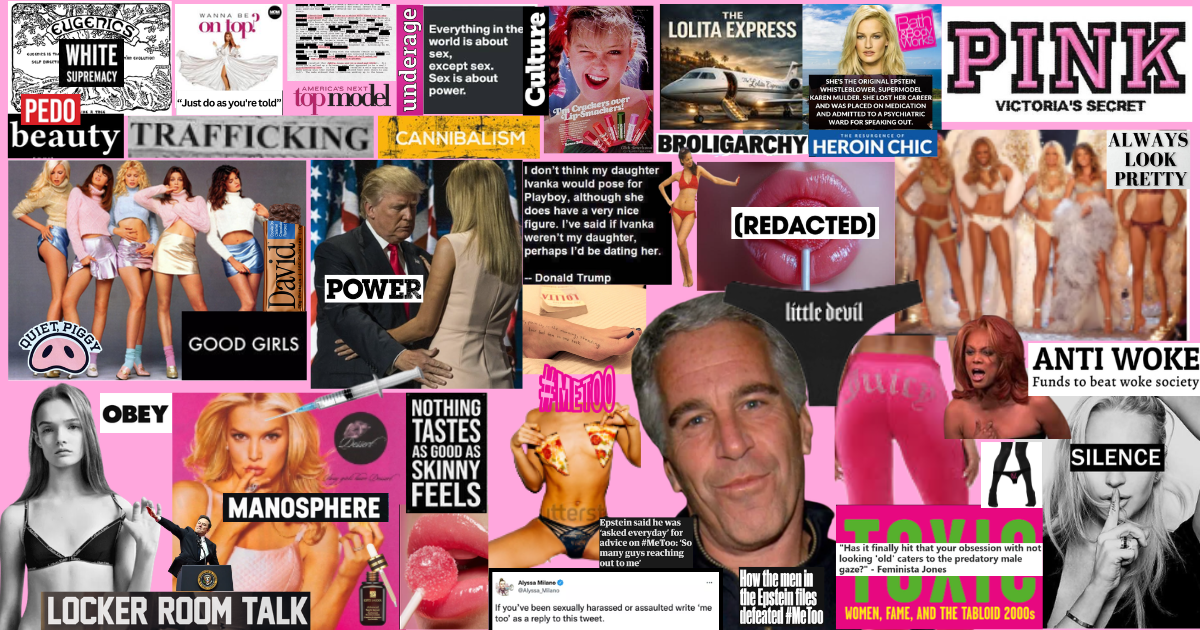
But why do I say everything is Epstein? It’s not theoretical. Fashion and beauty culture in the late ’90s and early 2000s were shaped by the Epstein “aesthetic.”

Brands like Victoria’s Secret, PINK, and Bath & Body Works shaped Millennial culture globally. They were everywhere: magazines, music videos, films, and they primarily targeted girls and teens. All of these brands belonged to L Brands, created by Les Wexner, whose finances and fortune were managed by Epstein. This is not an exaggeration. Epstein helped define what an entire generation of women was supposed to look like.

These brands didn’t just sell products. They defined desirability for a whole generation, merging youth with sexuality, putting pre-teen girls in thongs and push-up bras, and tiny shorts stamped “sexy” or “flirt.” And these brands spawned countless clones with massive influence. I still remember the Irish rape case where a 17-year-old girl’s underwear was used in court as evidence that she “was asking for it” because it had a logo saying “little devil.”

A generation of girls who grew up in the ’90s absorbed all of this: the clothes, the messaging, the plastic bodies in the shop windows. Many internalized these standards long before they had the language to talk about sexualization, power, or patriarchy. We’re talking about a very specific moment in history that can be precisely identified.

The women who grew up then are now 40+ and still trying to untangle issues of body image, sexuality, aging, and self-worth.

Jameela Jamil says this industry hasn’t just normalized the pedophilic horror story of Lolita (Epstein’s private jet was named after it), it glamorized it. The story of a girl groomed and then raped by her stepfather.

The Lolita ideal is still alive. It’s the aesthetic ideal: childlike and teenage features. To this day, post-MeToo, many women, even women in their 40s, go to great lengths to adjust their aesthetics, faces, bodies, voices, and behaviors to mimic 15-year-old girls. All for the male gaze.

Men who are secretly pedophiles and run podcasts try to tell us it’s natural for men of any age to desire teenagers due to higher fertility. They claim it’s biology and evolution. And yet Marilyn Monroe, in her 30s, was the ultimate global sex symbol.

Let’s say it again: beauty standards from the ’90s until today were created by men attracted to children.

America’s Next Top Model (another Netflix documentary that sparked discussion) exploited this culture, selling fashion and body positivity. But ANTM wasn’t just a competition, it was a reality show. The contestants were the product. Not just their bodies, but their pain, their suffering, their humiliation.

The girls had to follow orders, submit completely, starve themselves, risk their health, lose bodily autonomy (extreme mandatory makeovers), endure sexual abuse on camera, and then be gaslit and blamed. That was the only way to stay on the show. It’s exactly the same as Epstein’s promise: “Behave, do what we tell you without complaint, and we might promote you to become a famous model.” (These words appear throughout the files.)

And now to the bigger picture. An article by The Verge finally made everything make sense. It argues that the entire anti-woke movement appears to have been coordinated. It’s no coincidence that the worst people were in that circle: Peter Thiel, Elon Musk, Larry Summers, Steve Bannon, and of course Donald Trump. Their interests aligned. And they had a vested interest in crushing the hope of social justice.

The files show that the anti-woke movement was not driven by people who “cared about free speech.” Nor was it a grassroots movement of ordinary conservatives. It was a coordinated effort by an unimaginably powerful network of men who felt threatened by MeToo. Their emails suggest that Epstein himself organized actions against the movement.

Epstein’s influence campaign began in the early 2000s, especially in science. He closely monitored MeToo and acted as a consultant for men who saw themselves as victims of cancel culture. He wrote that with so many men being accused of harassment, he had become in demand and was asked for advice daily. The Guardian reports that in one email he wrote people were asking him, “when will this madness end?” A coordinated effort emerged to undermine both the movement and the women who spoke out.

At the same time, this shows something else: for a brief moment, MeToo achieved what no one expected: it limited the impunity of the powerful. In 2008, Epstein secured preferential treatment and near freedom despite charges. But in 2019, renewed scrutiny led him to federal prison, where he died awaiting trial for trafficking minors. That seems to have set off alarm bells.

And then look what happened. Peter Thiel made a strategic move that contributed to what I call The Great Regress™. He funded the so-called “vibe shift”, meaning the return of slurs as “edgy,” feminism as “cringe,” and the narrative that feminism is the enemy of men. “Anti-woke” became the convenient label that masked the real goal of avoiding accountability.

It was a brilliant strategy. The anti-woke movement sustained itself and snowballed. Journalists wanted something new after MeToo, but more importantly, every conservative male influencer, and every bro with a podcast, ran with it. They built their racist, homophobic, misogynistic rhetoric on top of it, monetizing a growing population of men who felt lost after consecutive economic crises and shifts in male identity.

White House invitations, handshakes, photos with Trump, none of it is accidental. The manosphere became the perfect laundering machine, washing away these men’s actions through a massive wave of misogyny that crashed over MeToo, and drowned it.

Epstein helped shape this reality. Because with enough money and power, you can create an entire culture that reverses the course of collective consciousness.

The article goes further. It suggests he may have played a role in destabilizing democracy in the US through alliances, ideological influence, and political connections, creating instability that served their interests. As he wrote to Thiel in 2016: “Brexit was just the beginning.” Exploiting collapsing systems is easier than finding new opportunities. (His words.) The article concludes that we are living in the world Epstein wanted. (And I haven’t even mentioned eugenics.)

Epstein had politicians from around the world sharing confidential government information with him, and he advised them on everything from taxation to military action. Under the guise of dinners and vacations on his island, he was shaping global political strategy. Except at those dinners, the main course was underage girls or, if you go deeper into conspiracy theories, even babies, something I’m increasingly inclined to believe.

In Theroux’s Netflix documentary on the manosphere, HS Tikky Tokky says it clearly: “the government owes us.” The manosphere was weaponized by forces that wanted a Trump government, against woke culture. Elon Musk buying Twitter and reinstating a platform for hate, was that random, or part of the plan? Yes, he’s unstable, but who’s to say someone didn’t plant the idea at one of those dinners, knowing he’d take the bait? At this point, nothing seems far-fetched to me. These connections make perfect sense. Plans can have multiple layers, plan A, B, C, and we only get to see 1%.

The traces get covered. The “liar’s dividend” is a manipulation tactic where deepfakes and AI-generated content allow public figures to claim real incriminating evidence is fake, helping them avoid accountability. In simple terms: they use the tech those exact billionaires own, create fake evidence, bury the real one, muddy the waters, and weaken truth itself, because it becomes impossible to know what or who to believe. As a bonus, they undermine trust in media and democratic institutions.

And it wasn’t that hard, because for years we turned a blind eye and laughed at those shouting that the elite was eating babies. We looked away while women survivors spoke out, and we let them be labeled crazy, institutionalized, or conveniently “disappeared.” And now, with wars all around us and democracy seemingly gone, we wonder how the hell we got here.

Well—it wasn’t out of the blue.

—Dig up the golf courses.


Share:

The High-Value Man myth and the real meaning of hypergamy

If you’ve ever searched for dating advice, you’ve probably run into terms like “high-value man,” “high-value woman,” and “hypergamy.” They’re everywhere in the manosphere, and almost always presented as unquestionable truth.

But here’s the reality: these concepts are not psychology, not science, and definitely not healthy dating guidance. They’re old patriarchal narratives repackaged as modern “male self-improvement.” And if you don’t understand where they come from, you’ll end up working on the wrong things and attracting the wrong relationships.

This guide breaks down the high-value man myth, explains hypergamy in the real sociological sense, and shows why these ideas still create confusion, insecurity, and loneliness for men today.

What “High-Value Man” really means (and why it’s misleading)

The manosphere uses “high-value” like it’s a personality category. But the idea didn’t come from psychology. It came from hierarchy-obsessed, alt-right-adjacent online spaces where men are taught to rank each other and women the way one would rank products.

Here’s the actual formula behind “value” in this ideology:

  • Men: money, status, dominance, success
  • Women: youth, beauty, purity, sexual selectiveness (ideally virginity)

This isn’t personal growth.
It’s gender stereotyping dressed up as self-improvement.

Some male coaches try to soften the idea by blending it with traits like integrity, honesty, responsibility, and leadership. But the core logic hasn’t changed:
it still assumes people have unequal value depending on gender roles created 100+ years ago.

Hypergamy explained without the myths

Hypergamy, in actual sociology, describes a historical pattern:

Women tended to marry men with higher socioeconomic status because for centuries they weren’t allowed to earn money, own property, or support themselves legally.

Marriage was survival. That’s it.

But the manosphere twisted this into:

“Women want only the top 10% of men.”

That’s not hypergamy.

That’s insecurity dressed as theory.

It’s based on outdated assumptions about traditional women who relied on men economically, not modern relationships where women work, earn money, and choose partners based on emotional connection, compatibility, kindness, attraction, and shared values.

What the manosphere never mentions: Men also “date up”

The original hypergamy model always had two sides.

Men consistently choose women who are:

  • more emotionally intelligent
  • more nurturing
  • more attractive (usually above their league)
  • better communicators
  • more socially connected

In traditional marriages, women carried 100% of the emotional labor while men received care, stability, sexual access, and legacy (children carrying their name).

In other words:
Both genders “married up,” just in different domains.

But the manosphere erased the second half to blame women for male loneliness.

Why hypergamic relationships still exist today

These dynamics still survive in couples who unconsciously internalize patriarchal gender roles:

  • Women give youth, beauty, sex, caregiving and emotional labor
  • Men give status, money and protection

This is not a modern relationship model.
It’s a leftover survival strategy from a world where women had no rights.

The real question today is:

Do you actually want to live in a dynamic designed for 1850?

Most men don’t, but they’ve never been shown the alternative.

The Real Problem: Assigning relative “value” to human beings

No credible therapist, psychologist, or relationship professional uses the term “high-value man.” Ever.

Why? Because human value is non-negotiable and equal.
What varies is:

  • emotional maturity
  • compatibility
  • communication skills
  • self-awareness
  • readiness for a relationship
  • shared goals and values

It’s not about who’s “higher value.”
It’s about whether your journeys align.

This framing is healthier, more accurate, and drastically more effective in real relationships.

So What Actually Makes Someone “High-Value” in Modern Relationships?

Not money.
Not youth.
Not dominance.
Not hotness.

Emotional skills.
The ones patriarchy never taught men:

  • vulnerability
  • self-regulation
  • empathy
  • communication
  • accountability
  • the ability to give and receive emotional care.

This is what makes someone a great partner today.
This is what creates long-term, fulfilling connection.

If You’re a man struggling with dating, here’s what to do instead

You don’t need to chase status. You don’t need to become an “alpha.”

You need to work on:

  • presenting yourself authentically, not performatively
  • improving your emotional communication
  • understanding your attachment patterns
  • building genuine relational confidence
  • healing insecurities (yes, everyone has them)
  • developing clarity around your values, boundaries, and dating goals.

These are the real foundations of healthy romantic connection.

If You Want Help With This Work

This is exactly the work I do with my clients. I help men (and women) break out of outdated gender scripts and build emotionally mature, healthy, equal relationships.

If you want support in:

  • understanding your patterns
  • improving your dating confidence
  • learning effective communication
  • building a compelling dating profile
  • navigating dating apps with clarity and strategy
  • and developing the emotional skills that matter in real relationships

You can inquire about working with me. No gimmicks. No “high value” games. No unethical practices. Just real relational growth that actually leads to love.

Share:

How did the manosphere become so popular?

Between the panic that all incels will turn into femicide perpetrators and the humor offered by alpha male influencers, let’s take a moment to understand why this is happening.

The global rise of feminism through pop culture and social media opened doors for many women’s communities. Women found empowerment spaces, gained platforms to speak, and for the first time, the world was (somewhat) paying attention. And the general message was “men are trash” for reasons we all know (which of course doesn’t mean all men, or that they are actually trash). But many men started feeling targeted.

Even worse, they felt marginalized. The manosphere was never made for handsome, wealthy men, but for the underprivileged—those who felt excluded from the dating scene (basically from sex), from relationships, and from love. For men who are poor and considered unattractive, and who are mostly not highly educated, it seemed like some kind of solution.

These men may have experienced rejection or even contempt from women in their lives, and haven’t processed the pain. Many may not have even dared make a move toward women, because they lack basic social skills. According to manosphere advice, all one needs is confidence, to lightly insult the woman, and to speak in riddles—then you can get any woman into bed.

These underprivileged men have been experiencing what’s been called the “male loneliness epidemic” for years. And they’re suffering. They needed someone to listen to their problems, someone to speak to them, when Hollywood, flashy influencers, and mainstream culture left them out. They needed guidance. There was a huge gap in the market.

And it didn’t take long for something to fill it. It started in gaming forums, and then expanded to other forums (4chan, Reddit), where they shared experiences, thoughts, and feelings—and this was genuinely positive, because many young men who had lived in social isolation finally gained a sense of community. They needed support—and they found it.

With the rise of video content, some figures stood out and became influencers. Some, like fitness influencers, pivoted into this niche because it was so lucrative. That’s how we got people like Jordan Peterson, who came with the seal of academic legitimacy (though he’s now been cast out of the academic community). He sensed the market demand for male role models and pseudo-scientific authority, exploited it, and became famous.

The problem is, instead of identifying the real enemy behind male oppression—which is The System, specifically Capitalism and Patriarchy (and White Supremacy)—they decided their enemy was feminism. In a distortion of reality, they use feminist arguments to convince their audience that men are victims of feminism. They quote stats on suicide, depression, addiction, etc., as proof. But they refuse to see that it’s patriarchy, the man-box, and the demands of stereotypical masculinity that are to blame.

They don’t blame patriarchy—because that would mean relinquishing privilege and comfort. So it’s more convenient to blame women and feminism. Why? Because feminism gave women the ability to survive without marrying, and the choice to not pair up with men they don’t like—in other words, not with them, the men who believe access to sex should be their right. So, feminism, and anything progressive, is the enemy.

And because a return to “traditional values” implies conservatism, all of this became embedded in alt-right rhetoric (which is not “alt” at all, but far-right). It became a package deal. While the manosphere crowd believes it’s unfair to have to pay for a woman’s coffee if they manage to get a date, at the same time they want right-wing politics and hate woke culture.

They don’t see the truth. And it’s ironic and tragic that they see as an enemy the very movement that is actually on their side—the movement that could genuinely improve their lives. Not by offering them sex. But by offering collective healing tools that could make relationships with women possible.

History of the Manosphere

It began in the early 2000s as a collection of blogs, forums, and YouTube channels focused on men’s issues. At some point, it started to function as a counter-movement to feminism.
The term “manosphere” emerged around 2009–2010 to describe the online ecosystem where these ideas developed.

Its foundations were built on older men’s movements, like the Men’s Rights Movement (MRM) from the 1970s–80s, which focused on divorce, child custody, and false rape accusations.

2000s–2010s:
Pickup Artists (PUA) led by gurus like Neil Strauss with his book “The Game”, which taught men how to “seduce” women—basically by saying things like “I like you, even though you’re a bit chubby” to get them into bed.

Mid-2010s:
The rise of Red Pill ideology (named after The Matrix), promoting the idea that men must “wake up” and realize that women actually hold power in society, while being inferior, dirty, immoral, etc.

2016–present:
Incels—the evolution of Red Pill thinking. Men who hate women and feminism for denying them access to sex.

MGTOW (Men Going Their Own Way):
Men who completely give up on the idea of relationships.

Connections to the far-right, white supremacy, anti-LGBTQ, and anti-woke rhetoric grow.
We see the rise of the “hustler” ideal through crypto culture—the man who makes loads of money and has as many women as he wants, using and exploiting them like objects. (See: Andrew Tate.)

Core Beliefs:

  • Biological determinism: Gender roles are biologically predetermined, and it’s foolish to try to escape them.
  • Men as victims: Men are the oppressed ones; we live under matriarchy; feminism is misandry and “feminazism.”
  • Cheap self-improvement: At the beginning, there was talk about self-care, confidence, and fitness—but misogyny got way more views. Over time, self-improvement shifted from a process of inner growth and healing into a performance of dominance and control. Instead of fostering emotional maturity, it became a show—a curated display of masculinity, power, and “social value.”
  • Monetization: Enter hustler culture, with millions of desperate men paying for subscriptions to ridiculous “gurus” offering seminars on how to get women or make money—naturally, with little to no real results. The promise was always the same: quick success, sex, power. The reality? Usually full of disappointment and burnout.

Impact

  • Connection to violence: Incels who went out and shot people (e.g., Elliot Rodger, 2014).
  • Platform bans: Reddit, YouTube, and Facebook started limiting manosphere content (2018–2020), but TikTok let them run wild for far too long. In 2022, Andrew Tate was banned, but he remains a legend, with countless others trying to take his place.
  • Legacy: There are still online corners where the manosphere thrives, but it’s no longer quite as “cool.” The “gym bro podcasts” are everywhere, but they’ve become meme-worthy. The slightly more polished successors of this ideology have shifted to life coaching and dating coaching, always with an emphasis on confidence—but still rooted in the same old worldview.
Share:

The Netflix series we needed

I made a video a while ago where, at the beginning, I mentioned that teenage boys can be somewhat scary and intimidating to women. A lot of people were outraged in the comments—why was I saying that? What did I mean? I explained:

“Teenage boys go through a phase where they need to prove their masculinity to one another and to the outside world. It becomes a performance, a spectacle, and unfortunately, this often translates not just into shouting loudly and swearing but also into harshness—because that’s what patriarchy has taught them. That sweetness and kindness are signs of feminine behavior and weakness, things to be avoided at all costs.”

In the introduction of my book, Who Women Want, I say that not all women want the same thing—because women are people. They are not bees with a hive mind.

The closest thing to a hive mind isn’t found in women but in boys growing into men. Not because boys are less intelligent or because they are simple creatures—none of that nonsense, don’t worry.

It’s because of the man-box. These characteristics that become the “masculinity meter,” the standard by which boys measure and evaluate one another, and anyone who deviates is pushed to the margins. That’s why breaking the cycle of stereotypical masculinity is so difficult—because of fear. Boys are constantly weighing and testing one another in a relentless effort to prove they are “man enough,” so they don’t fall in the hierarchy and risk being ostracized. Keep that word in mind.

Sophisticated, educated (or posh) types like us, who stand on the other side and fail to see the suffering of boys, who only see the shouting, the swearing, the bullying, and the behaviors we label as “toxic masculinity”, we bear responsibility.

We are the ones who use difficult words like ostracized and exclude them, and right when we talk about dismantling privilege, we flaunt it.

The anger toward difficult words reminded me of a play I watched last year that had me crying from start to finish: Another Thebes. It reminded me of a young man I once dated. We’d met online—our lives ran on parallel tracks, and we would never have crossed paths in real life. I called him The Bronx. I’d written about him:

“His vocabulary consists of about a hundred words. He’s uninterested in anything beyond his own life. He doesn’t read, gets bored even watching movies, and finds nothing enjoyable except women, motorcycles and food. We have absolutely nothing in common. He constantly insults me, belittles me, and sometimes it’s exhausting.

But I ignore it. I don’t know how I realized this, but I know he doesn’t mean any of it. And I don’t take it to heart, which even impresses me. It’s like he has to say these things, so I don’t think he’s ‘soft,’ so he appears strong in my eyes, to maintain some invisible, unknown standard that I can’t even fathom. He insults me and I tell him I want him. He replies with a hundred kisses, tells me he’s thinking of me, then insults me again—then says he wants to hold me tight.

He would get angry whenever I used difficult words—angry at me even though he was actually angry at himself.

One day, we had ordered pizza. We were sitting on the bed, and he was still eating. At that moment, I had let my guard down, and without thinking, I reached out and stroked his beard. It lasted a few seconds. He turned to look at me. Oh shit, I messed up, I thought—he’s going to have a go at me.

Instead, he said, ‘Irini, I have pizza, music, and you stroking my beard. It doesn’t get much better than this. I don’t know how I’ll ever get over it.’ And he didn’t say it sarcastically. But of course, right after that, he took it back and started insulting me again.”

Sometimes, you get a glimpse of the boy beneath the mask. Sometimes, they show it to you on purpose—because they know that you, the overly emotional woman, crave to see it. It’s precious to you, and you’ll do anything to protect it. So they show it to you in order to take advantage of you.

But sometimes, they can’t control it, and the mask falls. And beneath the man, there is the boy.

“Do you like me?”

That desperate need to be accepted and loved—a need that both men and women share. But men are only allowed to satisfy it through sex. The fact that they aren’t allowed anything else destroys them—because on some level, they know.

They see what they’re missing. They see the magical world of women, full of sharing, emotion, and touch that isn’t shameful. They see it through the glass, like The Little Match Girl, and they know it’s not for them.

A tenderness they can’t touch. And that makes them angry, but with a rage that has no clear target. They don’t know how to be angry at society, and they’re not yet capable of being angry at themselves. (That comes later—with addictions, gambling, substances and other self-sabotage and self-destructive habits).

So they get angry, because anger is the only negative emotion men are allowed to express. But beneath the tip of the iceberg, it’s not anger. It’s sadness. It’s grief. It’s the pain of losing something they never had, but could have had, if only they weren’t required to be men.

And when women deny them sex, the only form of intimacy they’re allowed to seek, that makes them even angrier. A rage that terrifies women, forcing them to live in fear. And so they get angry too. They insult men—all men—because they want to stop fearing them. And men, in turn, get even angrier, hating the women who reject them because they fear them. Many find comfort in the arms of the manosphere.

Even when they’re in relationships, many men only get a fleeting glimpse, just a sliver, of what true freedom could feel like. The freedom to not constantly fear your own shadow in a world that judges you by how masculine you appear to be. The freedom to be accepted as you are, to be told you are enough. A mere idea of what love might feel like. But that light and brilliance scare them because they’ve spent their whole lives in the dark.

They become avoidant. The tenderness of staying is unbearable. Just as they get close, they pull away again. The light is not for them. They prefer to keep a safe distance, wearing loneliness as armor, fortified in their stronghold of self-sufficiency and autonomy. This is the prison of masculinity—even within a relationship, even within a marriage.

I’ll bring money home and protect you (from whom?), and you’ll have food ready, sex available, a clean house, and care for me when I need it. Closeness and connection, in moderation, because it is blindingly terrifying.

And women are left with bitterness, which is a mixture of pain and shame. The bitterness of an overflowing river of tenderness that has nowhere to go because the one it’s meant for refuses to receive it, except as home care or emotional labor. Tenderness that freezes and hardens instead of flowing from its spring.

The light is not for them—unless they were lucky enough to have parents who had all the colors on their palette and the willingness and ability to paint outside the lines. The invisible privilege that becomes a kaleidoscope. Parents who were emotionally present. Parents who were intentionally boring. Parents who were generous givers, both in words and actions, of love and attention, love for who you are, not for what you achieve or accomplish. Predictably, consistently, unwaveringly.

Except for the rare few who managed to do it alone, even with parents in the grey. The greatest challenge is transcending masculinity itself. It’s what we beg men to do, but they won’t do it just because we beg. No matter how much we beg. It’s a singularity—a space-time anomaly. They need the right stimuli at the right moment, repeatedly, aligned with a sequence of experiences that slowly confirm an initially vague and unformed idea: Maybe something in the world we know isn’t quite right.

And once the singularity occurs, it takes effort—an effort few are willing to make. It takes curiosity. It takes time. It takes energy. But above all, it takes what we hear in therapy: lean into the uncomfortable. To lean in and sit with discomfort. Until it becomes familiar. Because new ideas and beliefs can be uncomfortable at first—like new shoes. You have to try them on, walk in them, break them in until they become part of you, fitting you perfectly, until you never look back. Not just because you chose them, but because if you ever try to wear the old ones again, you wonder how you ever endured the rotten soles and the holes that let water seep in.

“How did you feel when your father looked at you with shame?”
We talk about the male gaze toward women, but not about the male gaze toward men. The gaze that measures and evaluates. Are you man enough? And so many boys, so many men, feel ashamed of the male gaze upon them—because it finds them lacking, because ithe man they look up to is ashamed of them.

Shame—not for something they did, but for who they are.

“I don’t deserve hot chocolate; I shouted”
I don’t deserve that much grace. I don’t deserve that much kindness. I don’t deserve love for who I am because I am not good enough. Something inside me—or about me—excludes me from the privilege of being loved for who I am. Something, sometime, made me believe this. And I will carry it all my life, and so will those who come close to me. And if I don’t let it go, it will define me until I die. Or until I destroy another life.

“We have to accept that we could have done more.”
From this story, you will remember the boy. But you must also remember the father. He was as good as he could be, but he should have been better. How could he be better with the father he had? I don’t know. I do know that masculinity is a generational issue—and a social one.

We should have done more. Who? All of us.

Parents must be present. Teenagers must question their parents, they must stop seeing them as gods and recognize them as flawed human beings. And parents must accept this loss and step back, slowly, carefully, with a steady love and unspoken safety nets. Because only then can children move forward and surpass them.

The debt is not to the past but to the future.

The debt is to the next generation. But what do you do when the next generation moves backward instead of forward? When it rediscovers lies we thought we had left behind, repackaging them in new, shinier package, this time not in books no one will read, but in short-form videos with millions of views. Coated in baby oil on the arms of alpha male influencers on TikTok.

We were not prepared for this.

Parenting is the hardest job in the world, yet everyone is doomed to do it as an amateur. Clumsy, awkward, imperfect—at best. Or much, much worse. No matter how many resources, books, and mental health professionals exist, there will always be a gap in understanding. The world of teenagers will always be a mystery to the world of adults.

We were not prepared for the fact that while a child sits quietly in their room, staring at a screen, their life might slowly be unraveling. Invisibly. Silently. And boys have been taught not to ask for help. Why? Because they have to be men.

We should have done more. Who? Everyone. Children are not raised by their parents alone. They are not raised in a bubble or a greenhouse. Every child is shaped by every classmate and, therefore, by every parent at school. They are shaped by everything they see or read. By every celebrity who becomes a role model. By social media. By pornography. Every child is raised by society. We all take part in raising them. We need to do more.


Share:

The truth about incels

A modern feminist approach challenging the narrative & creating change

Incels are often seen as villains in many feminist circles. They are the enemy, just like feminism is their enemy. But there should be no war at all. In reality, the vast majority of men who identify as incels aren’t mass murderers but depressed, isolated and underprivileged men who harm themselves more so than others. Feminism ought to stand by their side, because feminism should mean empathy and solidarity.

The problem

Incels perceive themselves as having lower value as romantic or sexual partners than other men. They place excessive importance on physical attractiveness and financial prospects to attract women, and underestimate women’s preferences for intelligence, kindness and humour. Incels’ inaccurate perception of what women desire in partnerships, leads to blaming women as well as other men for their lack of romantic success.

The role of dating apps

Rejection on dating apps amplifies their beliefs, with adverse consequences on their mental health. They create a distorted self-perception with low self-esteem, develop maladaptive coping mechanisms, and avoid accountability for their actions. By projecting their insecurities onto external reality, they reinforce patriarchal values and dehumanize the women they seek to date, further reducing their chances of romantic success.

A vicious cycle

Rejection sensitivity refers to an individual’s heightened and often anxious response to the perceived possibility of rejection or social exclusion. It seems that in rejecting themselves and believing they will not be good enough for potential partners, incels believe everyone else will agree. This may contribute to self-isolation and hostile behaviour, making them more dismissive of others and resulting in an unfortunate self-fulfilling prophecy.

The solution

It’s time to stop blaming incels and start blaming the society that raised them. Unlearning harmful anti-feminist ideals and seeking education on women’s lived experiences, is the start. Learning to cultivate trust in humanity, building one’s self-esteem with deep work, by seeking social and mental health support and recognizing that romantic relationships are possible for everyone, is the key to creating meaningful change.

My work is to help and guide men through the path of escaping maladaptive thinking and behaviour patterns that harm them and their possibilities of forming healthy relationships. I can help men redefine their ideas of masculinity and femininity and understand the female experience. Understanding leads to empathy and empathy leads to connection, which is marks the start of relationships. Let me be part of your journey and guide you through. It’s time for change!

Share: