A while ago, I made an Instagram post that said the following:
“Men are so strong, fearless and protective that they claim they’d be willing to take on bears, gorillas and tigers to save a woman, but they don’t dare tell their friends to stop making sexist jokes, harassing women or raping them.”
And then, naturally, a hoard of misogynists showed up in the comments to bully and insult me. “Are you saying there are men who tell their friends to rape or harass women?”
I kept explaining that what I was actually saying was that most men hear or see things that could indicate their friends are harassing or raping women, BUT THEY SAY NOTHING.
I’d even made a video explaining exactly what we want men to say to other men in different situations. (I’ll put the text towards the end.)
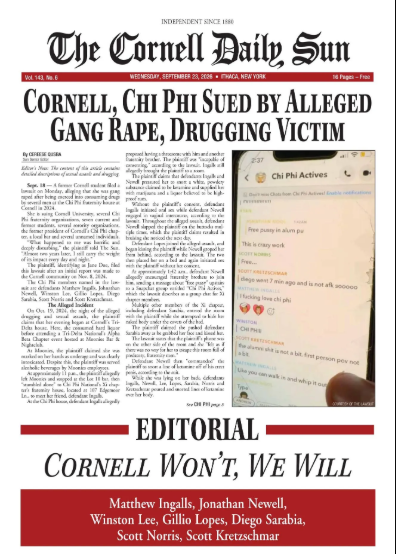
And then the Cornell case broke.
A few days after I learned what had happened, I posted a video about the horror Jane Doe had experienced. But I ended it with the thing that was troubling me the most: the group chat.
Because, yes, seven men (allegedly) decided to gang-rape her. But what did the other 50 men in the group chat do?
That was what I couldn’t stop thinking about. Almost more than the gang rape itself. Why?
Because there’s nothing we can do for the men who decide to rape someone. It’s too late. Teaching them about consent, or anything else, isn’t going to help. Even as someone who believes deeply in education, I know perfectly well how naïve that idea is. How delusional, actually. The problem wasn’t that these guys confused not saying no with “yes.” No.
Men like these know exactly what they’re doing. For them, the absence of consent is a bonus. It’s what they want. They want to dominate, humiliate and degrade a woman who doesn’t want to have sex with them, and is unable to fight back. And they want to high-five each other and bond through the whole experience.
For men like these, it’s too late for education. So the real issue is everyone else. The men who know what’s happening but don’t intervene.
Women’s Friendships vs. Men’s Friendships
The patriarchal stereotype about women’s friendships is that they aren’t true friendships, and that women are constantly fighting with one another. Part of this may have to do with the fact that women share genuine emotions with their friends rather than simply playing video games, playing sports, watching sports, or doing other activities together. (Is watching fishing a thing?) Their relationships are therefore deeper and more meaningful, involving vulnerability. But perhaps there’s something else going on, too.
Perhaps it has to do with the fact that when women see their friends doing something wrong, when they recognise shitty behaviour, they don’t automatically take their friend’s side. They don’t forgive everything as long as they themselves aren’t the target of the bad behaviour. They don’t blindly cover for their friends. They don’t look the other way. They don’t sweep things under the rug. They don’t say, “Oh, it’s okay, she’s my friend.”
If a friend does something wrong, not just to them or to another friend, but to anyone at all, women make an issue of it. They hold them accountable. They demand explanations. They expect repair and a change in behaviour. And if that isn’t enough, they cut them off.
That’s the difference.
Men proudly claim that male friendships are unshakeable and honest, and that men tell it like it is. Yet within their friendship groups, they avoid talking about anything that might disrupt the balance or challenge the stereotypes. They avoid rocking the boat.
They don’t call out problematic behaviour unless it’s directed at someone in their own group. Otherwise, and especially when it comes to women, even when they don’t actively bond through misogyny, they accept whatever their friends do without questions, accountability, consequences or confrontation.
“I didn’t see anything. I don’t know anything. I’m saying nothing.”
That, after all, is the bro code: a code of silence, himpathy and male solidarity.
Enter the Digital Bystander Effect
In a group chat, silence doesn’t necessarily mean agreement. But when everyone stays silent, the group can interpret that silence as agreement and acceptance. And that feeds a culture of violence, hatred and rape.
The digital bystander effect is the online version of the well-known bystander effect: the more people are present when something problematic is happening, the easier it can become for each individual to do nothing. It’s a paradox. The presence of many people makes each person less likely to take personal responsibility.
Responsibility becomes diffused throughout the group. “Someone else will speak up.” “Someone else will react.” “It’s not my business.”
In group chats, this is reinforced by the absence of the immediate social pressure that comes with a face-to-face reaction. You can read a message, say nothing and carry on with your life. People often choose passivity because they don’t want to get involved or draw attention to themselves.
In male group chats, this becomes particularly significant. Nobody wants to break the bro code and risk being cast outside the man-box. So countless men choose to remain silent, even when they disagree with what’s being said.
But they don’t have to agree. If 57 men see a message like that (or any message that objectifies or targets women) and nobody reacts, the silence acts as a social stamp of approval and acceptance. It’s digital locker-room talk, as Trump called it.
The person who sends the message encounters no resistance, and everyone else learns that this is a space where such things can be said without consequences. The sense of anonymity, distance and protection offered by a digital environment or a closed group can make people feel less accountable for what they say.
But words turn into actions. And we know that, from elite universities to the White House and the Epstein Files, closed groups can shape society as a whole and wield enormous power.
And yes, even Cornell lecturers agree that fraternities should be abolished. But fraternities are simply extreme versions of male friendship groups, where institutional rules don’t matter. The only rules that count are those of stereotypical masculinity.
Because patriarchy teaches men that they have two choices: be the hammer or be the nail.
Even if a man doesn’t really want to pick up the hammer, he sure as hell doesn’t want to be the nail. So he chooses the hammer. He can’t hit those above him on the hierarchy, but he’d better get busy hitting those below him.
He makes fun of men who rank lower on the masculinity scale, of “betas,” “simps” and weak men. He laughs at them. He bullies them. He puts them in their place. Whenever another man does something considered unmasculine, he insults him by calling him gay. He ridicules gay men. He keeps as much distance from them as possible.
And, obviously, he must be above women at all costs. He must keep them down, boot-on-neck.
Men are rewarded with status, safety, a sense of belonging and acceptance when they dominate women. In their everyday lives, masculinity is policed far more harshly than morality. And if a man values dominance, feeling powerful and proving his manhood more than he values not harming a woman, then rape becomes an almost… unforced outcome.
The consequences of being caught acting “feminine” are far worse than the consequences of acting immorally. Harming others is acceptable, while violating the rules of masculinity is unforgivable. You need power over women to preserve your masculine identity, and that requires constantly proving that you are man enough.
This is patriarchal male bonding, and it can start as early as primary school.
Right now, the only thing that can make a difference is the personal choice each man makes.
And let me remind you of something I’ve been saying for years:
Sometimes, saying “but I didn’t do anything” is not an excuse. Admitting you didn’t do anything, is a confession.
What can you do as a man, personally?
You can choose whether or not you want to maintain friendships that help sustain rape culture.
If you want to be a good man, speak up. Stand against cruelty, hatred, racism, homophobia and any behaviour you know harms people. Even if it costs you some friends. Yes, it takes courage. It takes bravery. But us feminists, we believe in you.
What if you’re in a group chat and someone says something you know is wrong? Something that perpetuates harmful stereotypes or could hurt women or other oppressed groups?
Don’t stay silent. Don’t be a bystander. Intervening doesn’t necessarily mean giving a lecture or publicly denouncing your friend. You can interrupt or defuse the message, name the problem, explain why it’s problematic or, when there’s a more serious risk, seek help or privately support the person being targeted.
What can you say to your friends when they talk about women?
- If you hear jokes portraying women as inferior, stupid, crazy or fitting any other negative stereotype, don’t laugh. Ask: “What do you mean by that joke? Explain it to me.”
- Say: “Don’t call women whores. If you do it again, you’re out of this group chat.”
- Say: “Don’t talk about women as if they were objects or pieces of meat. Women are human beings.”
- Say: “Rape jokes aren’t funny. Cut it out.”
What if it’s about dating and sex?
- “She’s drunk. If you take her home, she can’t give consent.”
- “Leave her alone. It’s obvious she’s not just not-interested, she’s actively trying to avoid you.”
- “You’re being creepy / you’re violating her boundaries/ you’re making women uncomfortable.”
- “Don’t touch women unless they’ve clearly shown you they want you to.”
- “Don’t keep insisting or pressuring her for sex if she’s told you she only wants kissing and cuddling.”
- “If she doesn’t seem enthusiastic, stop.”
- “Silence doesn’t mean yes. If she doesn’t seem genuinely keen, why not just watch a movie instead?”
- “Being in a relationship doesn’t mean automatic consent. She needs to say yes. Ask her if she wants to.”
- “If she says no, stop insisting. Don’t try to convince or pressure her.”
- “What she was wearing, where she was or how much she had to drink, has nothing to do with whether she wanted it.”
- “It’s never her fault if you crossed her boundaries.”
- “It’s not her responsibility to protect herself from what we do. It’s our responsibility not to harass women, violate or rape them.”