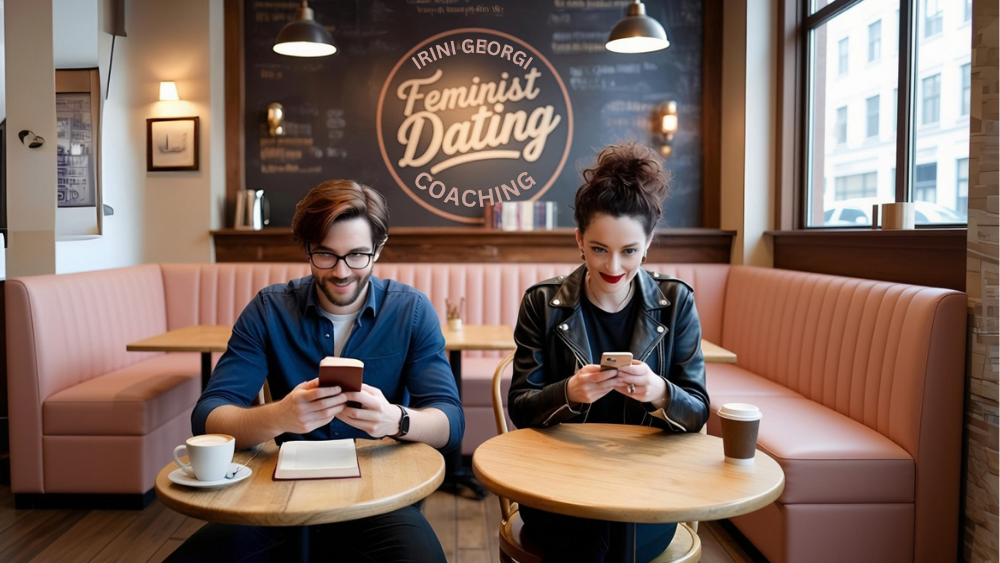
Irini Georgi

What does feminist dating coaching mean in practice?

If you’re wondering what feminism has to do with dating, and why I offer dating coaching while constantly talking about patriarchy on social media, I’ll explain it briefly here.

The way we behave in dating, in relationships with the opposite sex, and in our romantic lives more generally, reflects how we have learned to think and behave from a very young age, within society. It’s no coincidence that most male dating coaches talk about alpha males, PUA techniques, and how to “play the game.”

The ideas we have about masculinity and femininity, about what the “right” man and the “right” woman should be like, what the roles of each gender should be, and how the dynamics between them should work, have a profound impact on our relationships. And, of course, there is the idea that men want (and should want) sex, while women want (and should want) relationships.

Messaging & Approach

A sexist approach can be apparent from the very first messages on dating apps or social media, and from the very first lines used in real life.

That’s why I teach my male clients, men who want and are trying to be good men, how to put themselves in a woman’s shoes, what the female experience is like, how a woman might think, and what she expects to see from a man, so they can understand how to send the right messages and how to make them cute, funny and interesting.

From the women’s side, I teach them how to identify and recognise problematic rhetorical patterns in men’s messages or words that may conceal sexism or problematic behaviours. I very often see women ignoring signs, or not noticing them at all, that are screaming danger or a values gap from a mile away. And sometimes I explain why a message they didn’t like, without knowing exactly why, was actually sexist.

The Date

There are dozens of small situations and behaviors on a date that are influenced by patriarchy, and it’s not just about “who pays.”

It’s about how the suggestion of where and how you’ll go is made, where you’ll meet, what exactly you’ll do during the date, whether it will be coffee, drinks, dinner or another activity, what time you’ll go and what time you’ll return, whether you’ll go for a walk, and of course, physical proximity and touching during the date.

Communication & Connection

Under patriarchy, men are taught to talk about themselves and not listen, or show much curiosity about a woman’s life, while women are taught the opposite.

Here, I help men develop active listening skills, as well as learn to ask clarifying questions. The focus needs to shift from “I need to impress” to “I want to connect.”

Women, on the other hand, need to learn to focus on “I don’t just want to test him, I also want to have fun.”

Kissing & What Comes Next

The conversations I have with my clients about kissing, especially with men who carry the burden of initiating because of patriarchy, are endless.

From when the right moment is and how we know it’s the right moment, to actual technique. And then come the even more complicated questions, such as how to ask her to go home with you, when to say it and how to inspire trust from the beginning, how to make her feel comfortable, and even what your home should be like.

Sex & Pleasure

This is where consent comes in. Fortunately, I don’t have to discuss much of this with my male clients, because they know all about it. The difficult conversations happen with women and the experiences they have had, so that they can understand that they were not responsible, and then learn to recognise earlier what they don’t want to experience again, set boundaries and move forward.

At the same time, we focus on desire and expressing it, rather than using sex as part of a strategy to prevent the other person from losing interest.

Relationship Dynamics

All of this is only the beginning. Because then we move on to relationship dynamics, which are once again influenced by patriarchy.

The (supposed) sexual liberation made casual relationships and situationships possible, but it did not eliminate the inequalities within them. Because of the demands of stereotypical masculinity, men are more often unwilling to commit, wanting instead to have sex with as many people as possible without the responsibilities of relationships, while women have grown up longing for someone to choose them.

Attachment Patterns

Patriarchy is responsible for raising men who are less emotionally available than women, and often lack the emotional skills and capacity, the emotional endurance to tolerate negative feelings, and therefore the ability to give and “hold” more emotionally.

And this brings us to attachment patterns. Because men are discouraged from expressing emotions and vulnerability as they grow up, they are more likely to have avoidant tendencies, while women, who are taught that they need to earn validation, are more likely to have anxious tendencies.

Here, I introduce new perspectives and we learn new habits, so that we can move beyond the self-protective patterns that have begun to prevent us from finding happiness.

So, what does feminist dating coaching actually mean?

It’s not about learning “tricks” to make someone want you or get someone to choose you. It’s about understanding how what we have learned about gender, desire, relationships and our own worth affects the way we flirt, choose, communicate, have sex and relate to one another.

It’s about learning to recognise real danger without being afraid of every difficulty. Setting boundaries without building walls. Giving people opportunities without abandoning yourself. Being able to say “no,” but also “yes” consciously, because you genuinely want to.

And, ultimately, stopping trying to win someone’s love and starting to build relationships based on desire, freedom, reciprocity and connection.

These are just some of the things we work on together. If you want to better understand your own patterns, communicate differently, and approach dating with more self-awareness and fewer “strategic games,” fill out the form and I’ll get in touch with you directly.
Share:

Dating and mental health

The Problem with Dating Apps

It’s important to remember that dating apps are available for free to anyone who downloads them, or at least they have a free version, and they belong to business giants such as Match.com. Each app, therefore, is a capitalist product. These companies didn’t create them to save the world or help us find love (even if some began with that ideal), but to profit from those willing to pay.

Their goal is to keep us using the apps, just like social media platforms are designed to do. The only difference is that when you add the possibility of finding love, the platform becomes even more irresistible. They use gamification elements such as swiping, matching, challenges, and badges that mimic casino games like slots or fruit machines. This creates an addictive environment that’s difficult to walk away from.

How to Use Dating Apps Mindfully

First, we need to shift our mindset around dating apps. We must let go of the stigma that says, “If I need to use dating apps, something’s wrong with me, so I feel ashamed and use them secretly.” Ironically, that guilt fuels problematic use.

Next, it’s best to go into apps with a clear intention. Know why you’re there, don’t just download Tinder out of boredom. Don’t see apps as a game but as a tool.

We need to observe ourselves and the moments when we feel the urge to open an app, whether it’s to create a profile or simply to do some swiping during the day. If you just broke up with someone two hours ago, it’s not the best time. If you’re feeling low, lacking confidence, and craving a dopamine hit (even though that’s when most people fall into the trap), again, not the best time.

As I often tell my clients, your dating app profile is to your romantic life what LinkedIn is to your professional life. Take it seriously, put time and energy into it, but use it wisely.

For example, set your own boundaries on how long you spend on apps each day (unless you’re in a flowing conversation with someone specific). Otherwise, avoid staying on them for more than 20–30 minutes a day. Do your swiping, filter potential matches, send one or two messages, and log off.

Note: When (straight) women first join apps, the number of incoming matches can be overwhelming. They often end up going on three, four, or even five dates per week during the first month, which leads to burnout, as dating can be emotionally draining. The result? They delete the app, only to reinstall it later when they get bored again and need validation. To avoid this cycle, moderation and discernment are key.

Dating & Attachment Styles

Modern ways of meeting people and new technologies have changed our romantic landscape, and therefore, the kind of emotional support people now need in dating.

For example, anxious types (who are often women) tend to circle around the existential question: “Why am I not being chosen?” They often find themselves trying to “fix” situations that are not meant to be fixed, starting from the foundational anxiety of “Why isn’t he texting me?”

There’s a strong connection between anxious attachment and emotional burnout from excessive app use, something more common among women. On the other hand, men often experience rejection sensitivity, which can lead to lower self-esteem.

Core Beliefs & Dysfunctional Patterns

Everything related to mental health is also related to dating, because everything we are, everything we’ve lived through, and everything we carry inside us is projected onto our romantic and relational field and onto every partner or potential partner.

The need for connection and all our efforts that stem from it, even through a series of relationships that didn’t go well or experiences we labeled as “failures”, they all play an essential part in a process we can’t understand until we see it looking backwards. Even while we may be suffering deeply, something essential is being transformed.

This process mirrors our behavioral patterns, the roles we play in relationships, how we interpret situations, what we keep doing (even when it doesn’t work), and how we can change it using the right tools.

The goal is to become aware of why we do what we do, to feel compassion for ourselves for having developed these protective coping mechanisms, and even admiration for our own inventiveness. Then comes the stage of taking responsibility and stepping into maturity.

The real challenge is to rediscover and gently return to our authentic, wise self, the one who doesn’t fear, doesn’t feel threatened, and therefore no longer needs to act in the same self-protective ways. That’s the level where true healing happens.

If you’d like to explore how to manage situations that affect you negatively during dating or new relationships, I’m here to help. Fill out the form, and I’ll get in touch!

Share:

What dating apps really have to offer

Dating apps entered our lives within the last decade. Online dating already existed through social media or dating websites (mainly in the U.S.), but apps made the whole thing far more accessible and widespread, because you literally have them in your hand all day through your phone.

What they offer us is choice. It’s like being in ten or a hundred bars every night, while sitting at home in your pajamas. That didn’t exist before. You had to seize the moment when you were out and actually make a move, otherwise you’d have to wait until next Saturday night.

Dating apps also brought what we call an intentional approach to dating, that is, the ability to date with purpose, something people have always wanted, but couldn’t easily do before on their own initiative.

You couldn’t just decide to go on a date because you felt like it; you relied on introductions through family (matchmaking), community, or church. In short, dating apps are a valuable tool, as long as you learn to use them safely, responsibly, and a little cleverly.

But it’s important to note: through apps you meet people. You don’t date them. In reality, they’re introduction apps. You meet another human being, the app simply does the introduction. “Romeo, this is Juliet. You both enjoy drinking latte and going for walks. Good luck.”

Once you’ve met the other person, whatever relationship develops between you becomes something self-standing, completely independent from the app. It’s important to understand this, because very often people find excuses for themselves and justify their behavior in app-based connections, avoiding accountability.

But really, people we meet on the apps aren’t different from people we meet elsewhere. We owe them the same level of respect we owe to anyone in “real life”.


Why does Gen Z seem to use dating apps less than previous generations?

First, there’s a common saying about dating apps:

“Everyone hates them but everyone’s on them.”

As for Gen Z, part of the phenomenon has to do with the world they inherited, which unfortunately isn’t the same as the one previous generations grew up in.

Repeated economic crises, the pandemic, the housing crisis, growing conservatism, the collapse of dreams and expectations, and a general sense of hopelessness about the future, all of these have contributed to what we now call the male loneliness epidemic.

These factors make this generation operate under a cloud of uncertainty, unsure whether they’ll ever live what we once called a “conventional life”, with a house, family, and children.

That can lead to a kind of resignation in the search for partners, especially among men who still identify with the traditional gender role of being the provider.

On the other hand, this generation, the dating app natives who grew up with the apps, are also in a position to reject them.

A more progressive segment doesn’t want to depend on tech giants (broligarchs), algorithms, or the AI that has now entered the dating space. They crave more authentic interactions, not mediated by technology.

(A more conservative segment, on the other hand, wants to get married at 22, with trends like “trad wife”, and some young women’s dream is to stay home baking bread and raising children),

Meanwhile, studies record “swiping fatigue”, meaning exhaustion from constant app use, from superficial connections, and from the vicious cycle of situationships that often emerge through them.

We also see a longing for something more meaningful, a nostalgia for something they never really experienced, like the “meet-cutes” of 90s romantic comedies, those magical accidental encounters in real life, that tend to disappear.

There’s a connection to social media trends like “main character energy”, seeing yourself as the protagonist of your own movie and manifesting. In a way, these are coping mechanisms for a pretty dystopian reality, where the only answer and solution seems to be magical thinking.

It all comes back to something I often tell my clients: You have to actually do something to meet new people. You can’t expect a gorgeous neighbor to knock on your door asking to borrow a cup of sugar, or to find the love of your life in your fridge. Unfortunately, life isn’t a rom-com.

If you want to learn how to use dating apps the right way, I can help you build your ideal dating profile with the right photos and a bio that represent you in the most flattering, authentic way. Fill out the form and we’ll take it from there!

Share: