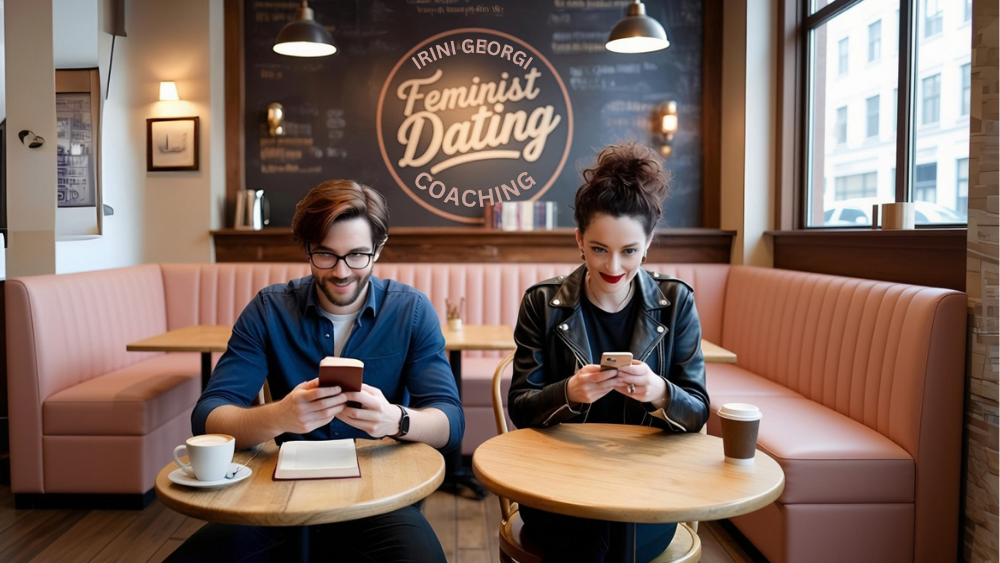
If you’re wondering what feminism has to do with dating, and why I offer dating coaching while constantly talking about patriarchy on social media, I’ll explain it briefly here.
The way we behave in dating, in relationships with the opposite sex, and in our romantic lives more generally, reflects how we have learned to think and behave from a very young age, within society. It’s no coincidence that most male dating coaches talk about alpha males, PUA techniques, and how to “play the game.”
The ideas we have about masculinity and femininity, about what the “right” man and the “right” woman should be like, what the roles of each gender should be, and how the dynamics between them should work, have a profound impact on our relationships. And, of course, there is the idea that men want (and should want) sex, while women want (and should want) relationships.
Messaging & Approach
A sexist approach can be apparent from the very first messages on dating apps or social media, and from the very first lines used in real life.
That’s why I teach my male clients, men who want and are trying to be good men, how to put themselves in a woman’s shoes, what the female experience is like, how a woman might think, and what she expects to see from a man, so they can understand how to send the right messages and how to make them cute, funny and interesting.
From the women’s side, I teach them how to identify and recognise problematic rhetorical patterns in men’s messages or words that may conceal sexism or problematic behaviours. I very often see women ignoring signs, or not noticing them at all, that are screaming danger or a values gap from a mile away. And sometimes I explain why a message they didn’t like, without knowing exactly why, was actually sexist.
The Date
There are dozens of small situations and behaviors on a date that are influenced by patriarchy, and it’s not just about “who pays.”
It’s about how the suggestion of where and how you’ll go is made, where you’ll meet, what exactly you’ll do during the date, whether it will be coffee, drinks, dinner or another activity, what time you’ll go and what time you’ll return, whether you’ll go for a walk, and of course, physical proximity and touching during the date.
Communication & Connection
Under patriarchy, men are taught to talk about themselves and not listen, or show much curiosity about a woman’s life, while women are taught the opposite.
Here, I help men develop active listening skills, as well as learn to ask clarifying questions. The focus needs to shift from “I need to impress” to “I want to connect.”
Women, on the other hand, need to learn to focus on “I don’t just want to test him, I also want to have fun.”
Kissing & What Comes Next
The conversations I have with my clients about kissing, especially with men who carry the burden of initiating because of patriarchy, are endless.
From when the right moment is and how we know it’s the right moment, to actual technique. And then come the even more complicated questions, such as how to ask her to go home with you, when to say it and how to inspire trust from the beginning, how to make her feel comfortable, and even what your home should be like.
Sex & Pleasure
This is where consent comes in. Fortunately, I don’t have to discuss much of this with my male clients, because they know all about it. The difficult conversations happen with women and the experiences they have had, so that they can understand that they were not responsible, and then learn to recognise earlier what they don’t want to experience again, set boundaries and move forward.
At the same time, we focus on desire and expressing it, rather than using sex as part of a strategy to prevent the other person from losing interest.
Relationship Dynamics
All of this is only the beginning. Because then we move on to relationship dynamics, which are once again influenced by patriarchy.
The (supposed) sexual liberation made casual relationships and situationships possible, but it did not eliminate the inequalities within them. Because of the demands of stereotypical masculinity, men are more often unwilling to commit, wanting instead to have sex with as many people as possible without the responsibilities of relationships, while women have grown up longing for someone to choose them.
Attachment Patterns
Patriarchy is responsible for raising men who are less emotionally available than women, and often lack the emotional skills and capacity, the emotional endurance to tolerate negative feelings, and therefore the ability to give and “hold” more emotionally.
And this brings us to attachment patterns. Because men are discouraged from expressing emotions and vulnerability as they grow up, they are more likely to have avoidant tendencies, while women, who are taught that they need to earn validation, are more likely to have anxious tendencies.
Here, I introduce new perspectives and we learn new habits, so that we can move beyond the self-protective patterns that have begun to prevent us from finding happiness.
So, what does feminist dating coaching actually mean?
It’s not about learning “tricks” to make someone want you or get someone to choose you. It’s about understanding how what we have learned about gender, desire, relationships and our own worth affects the way we flirt, choose, communicate, have sex and relate to one another.
It’s about learning to recognise real danger without being afraid of every difficulty. Setting boundaries without building walls. Giving people opportunities without abandoning yourself. Being able to say “no,” but also “yes” consciously, because you genuinely want to.
And, ultimately, stopping trying to win someone’s love and starting to build relationships based on desire, freedom, reciprocity and connection.
These are just some of the things we work on together. If you want to better understand your own patterns, communicate differently, and approach dating with more self-awareness and fewer “strategic games,” fill out the form and I’ll get in touch with you directly.